


The FIFFCO Fire Systems FG Series Clean Agent Fire Extinguishing System utilizes FG-200 (HFC-227ea) as the primary extinguishing medium. FG-200 (HFC-227ea) is a colorless, electrically non-conductive, and non-toxic clean agent, ideally suited for the protection of high-value and sensitive assets. It is specifically designed for use in normally occupied spaces, locations where post-fire clean-up is critical, areas with limited storage capacity for suppression agents, and environments requiring a non-conductive fire suppression solution.
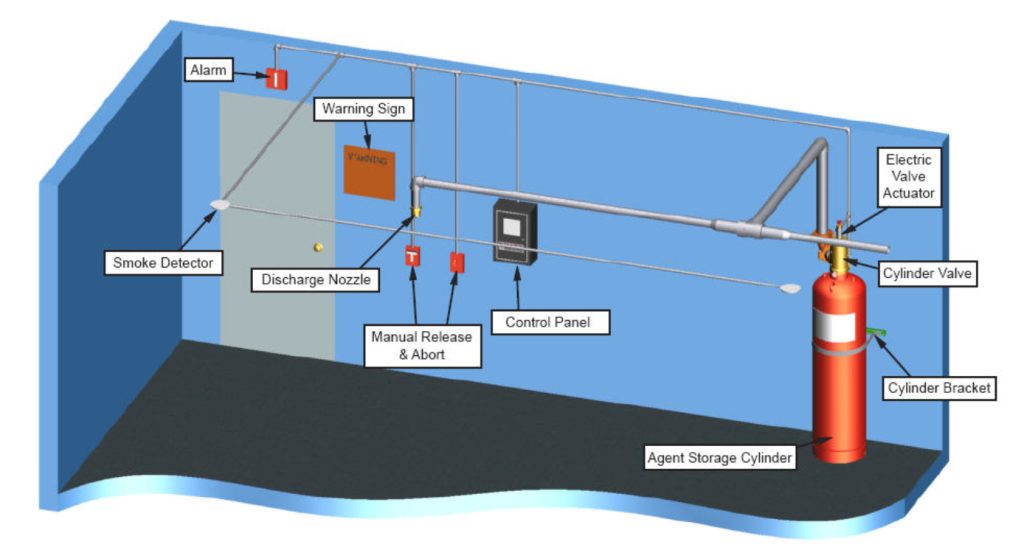
Each FIFFCO FG Series FG-200 system is supplied as a complete, engineered package consisting of the following system components and their associated accessories:
Storage components consist of the cylinder assembly(s) containing the HFC-227ea clean agent, along with the cylinder bracket(s) that securely support and hold the cylinder assemblies in position.
Storage components consist of the cylinder assembly(s) containing the HFC-227ea clean agent, along with the cylinder bracket(s) that securely support and hold the cylinder assemblies in position.
Trim components complete the installation and operation of the FIFFCO FG-200 fire suppression system. These components include connection fittings, pressure gauge, low-pressure supervisory switch, electric valve actuator, and manual valve actuator.
Slave arrangement components are used for multiple-cylinder installations and consist of pneumatic valve actuator(s), actuation check valve, bleed valve, pilot hose, and required fittings for proper system synchronization.
Supplemental components include the discharge pressure switch and manifold check valve. These components support the core system equipment and enable specific multi-cylinder system configurations.
The control panel continuously monitors the status of the electric actuator, detection devices, warning appliances, cylinder pressure, and all manual release and abort stations. All electric and electronic system devices must be connected to the control panel for proper system operation and supervision.
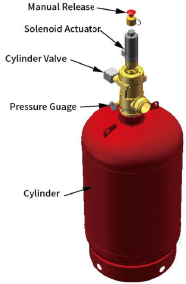
The automatic release of FG-200 (HFC-227ea) is controlled by a forged brass, differential pressure–operated cylinder valve connected to the cylinder neck. The valve assembly is supplied with an anti-recoil safety device installed at the discharge outlet and securely chained to the cylinder valve for safe handling.
A high-accuracy pressure gauge is provided to continuously indicate the internal pressure of the cylinder, ensuring proper system charge and readiness.
A threaded, rigid dip tube extends from the cylinder neck to the bottom of the cylinder, ensuring full and efficient discharge of the agent during system activation.
The light-walled, welded-seam steel cylinder is manufactured in compliance with TPED requirements. The internal neck threads allow secure connection of the cylinder valve. The cylinder is designed exclusively for vertical mounting to ensure correct operation and maximum safety.

A threaded connection located on the top of the cylinder valve serves as the attachment point for either the electric (primary) valve actuator or the pneumatic (slave) valve actuator, depending on the system configuration.
A female-threaded connection is provided for mounting the pressure gauge. This connection is equipped with an internal check valve, allowing safe removal of the pressure gauge while the cylinder remains pressurized.
The discharge outlet consists of either a 1¼ in. (33 mm) or 2 in. (49 mm) male-threaded connection, which serves as the attachment point for the discharge piping network.
A ¼ in. (8 mm) FNPT connection, supplied with a removable plug, is provided for applying actuation pressure to slave cylinder(s). In single-cylinder system arrangements, this port may also be used for the installation of a discharge pressure switch. The port becomes pressurized only during the 10-second discharge period.
FG-200 (227ea) is a clean agent composed of the elements carbon, fluorine, and hydrogen with the chemical formula CF₃CHFCF₃ (Heptafluoropropane). The primary fire extinguishing mechanism of HFC-227ea is heat absorption, with a secondary chemical extinguishing effect occurring through thermal decomposition of the agent within the flame zone.
FG-200 (227ea) leaves no residue and is safe for use in normally occupied spaces when applied in accordance with applicable standards. Most common construction and system materials-including aluminum, brass, steel, cast iron, lead, stainless steel, and copper-as well as rubber, plastics, and electronic components, are not affected by exposure to FG-200 (227ea).
Although the EPA Significant New Alternatives Program (SNAP) lists FG-200 (227ea) as acceptable for use in occupied spaces, both NFPA 2001 and SNAP provide the following key guidelines for human exposure: