




Published: April 2026 | Last Updated: April 2026 Author: Fiffco Global Technical Team | Reviewed by: Fire Safety Engineering Specialist
Introduction
Imagine a 15-storey commercial office block in central London. At 2:00 AM, a faulty power strip in a third-floor server room begins to smoulder. Within minutes, the smoke triggers a detector. In a building this size, the difference between a “Zone 3 Fire” notification and a precise “Room 304, Rack 2 Smoke Detection” alert isn’t just a matter of technical preference—it is the difference between a rapid, targeted response and a chaotic, floor-by-floor search that wastes precious minutes.
For facility managers and building owners, selecting between fire alarm system types—specifically conventional and addressable—is one of the most critical infrastructure decisions you will make. According to UK fire statistics, delayed discovery and unclear location data remain primary contributors to property damage. When the alarm sounds, your system needs to do more than just make noise; it needs to provide actionable intelligence.
This article solves the “which one do I need?” dilemma. We will break down the technical architecture of both systems, explore the cost-to-benefit ratios for different building scales, and align these choices with current safety regulations. Whether you are retrofitting a heritage warehouse or designing a new industrial complex, this guide provides the clarity required to ensure life safety and regulatory compliance.
By the end of this deep dive, you will understand the granular differences in wiring, the nuances of “false alarm” management, and how to specify a system that meets the rigorous standards of UL and FM Approvals. We speak from a decade of experience in manufacturing and supplying these systems globally, ensuring your choice is grounded in engineering reality, not just a sales brochure.
What Are Fire Alarm System Types? (Definitions & Overview)
In the fire protection industry, we generally categorise systems based on how they communicate. At its simplest, a fire alarm system is an ecosystem of inputs (detectors) and outputs (sounders) managed by a central control panel. However, the “intelligence” of that communication varies significantly between conventional and addressable setups.
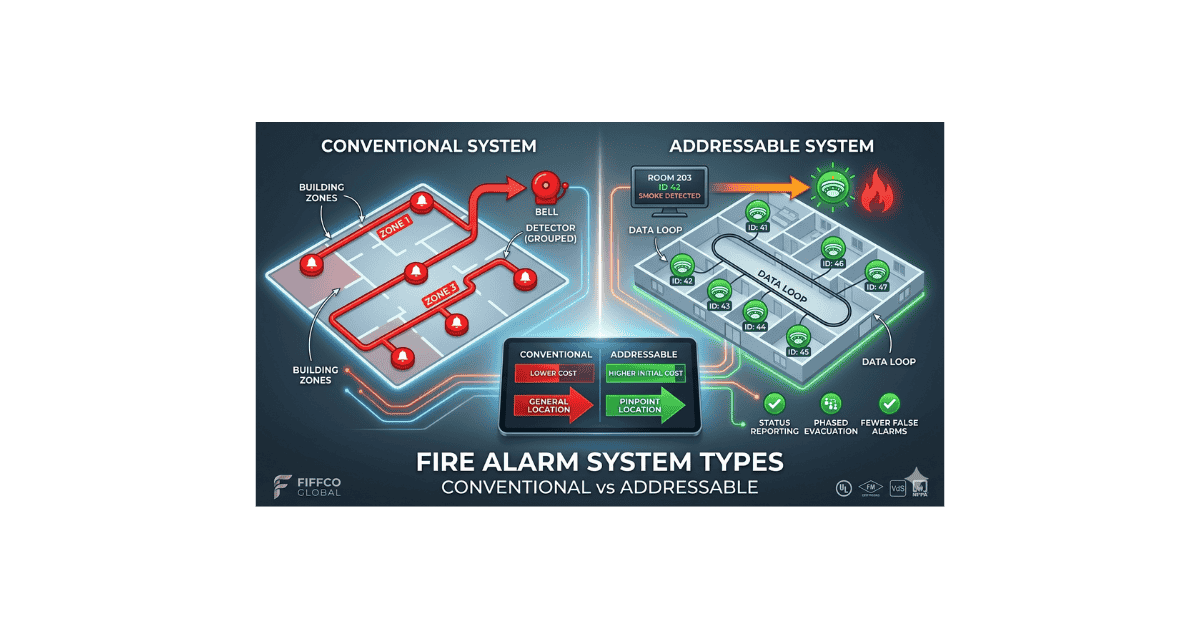
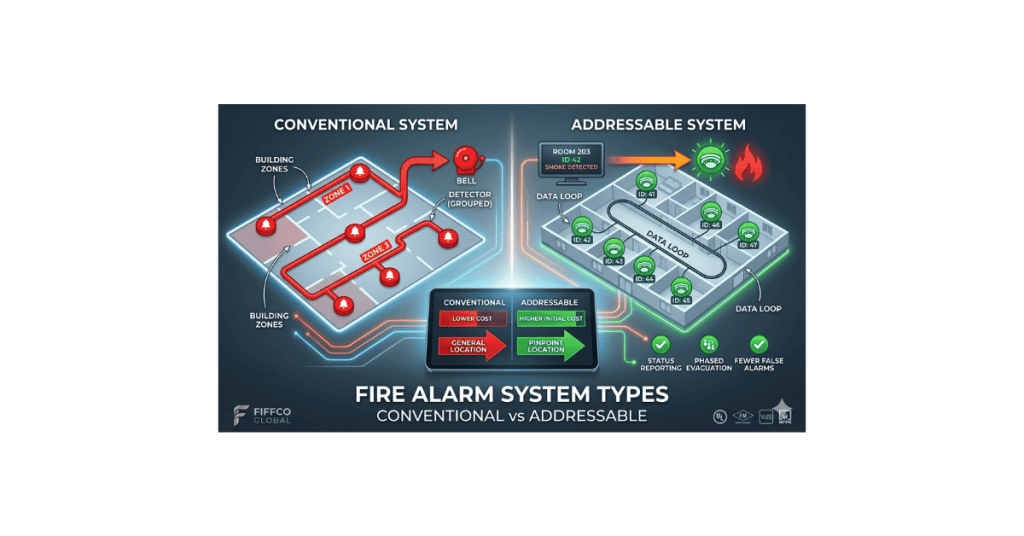
Conventional Fire Alarm Systems A conventional system is an analogue setup where the building is divided into “zones.” All devices in a specific area—say, the ground floor—are wired to the same circuit. If a detector activates, the panel tells you which zone is in alarm, but it cannot identify the specific device. It is a “binary” system: either the circuit is clear, or there is a fire somewhere on that line. These are typically used in smaller, less complex environments like shops or small offices.
Addressable Fire Alarm Systems An addressable system is a digital network where every single device (smoke detector, heat sensor, or call point) has its own unique “address” or ID. The control panel communicates with each device individually. This allows the system to pinpoint the exact location of a fire. Furthermore, addressable systems are often “intelligent,” meaning they can report their own health status, such as “Detector 45 needs cleaning,” rather than just triggering a fault.
Why the Distinction Matters The choice between these fire alarm system types dictates your building’s life safety posture. Addressable systems offer superior property protection because they allow fire crews to bypass the “search” phase and move directly to the source of ignition. For complex facilities, this saves time, reduces water damage from sprinklers, and minimises business downtime.
Key Components and How They Work
Understanding the anatomy of these systems helps in identifying where your investment goes. While both systems use similar-looking hardware, the internal logic is vastly different.
The Fire Alarm Control Panel (FACP)
The FACP is the brain of the operation. In a conventional system, the panel monitors the electrical current on a zone circuit. A drop in resistance (caused by a detector triggering) signals an alarm. In an addressable system, the FACP acts like a server, constantly polling every device on a “loop” to check its status. Pro Tip: Always ensure your FACP has “event logging” capabilities to help investigators trace the cause of any incident.
Initiating Devices (Detectors and Call Points)
These are the “sensors” of the system. They include smoke detectors, heat sensors, and manual call points (break-glass units). In an addressable system, these devices can be programmed with custom labels, such as “Staff Canteen – South Wall.” In a conventional system, they are anonymous components of a larger circuit. Real-world example: In a high-end hotel, an addressable smoke detector in a specific guest room allows security to check the room immediately without alarming the entire wing, preventing unnecessary mass evacuations for a burnt piece of toast.
Notification Appliances (Sounders and Strobes)
These are the outputs that alert occupants. Modern addressable systems allow for “phased evacuation.” For instance, the system can sound a continuous alarm on the fire floor and the floor above, while giving an “alert” tone to other levels. This prevents stairwell congestion in high-rise buildings—a critical factor in life safety engineering.
Relevant Standards & Compliance (UK & International)
Compliance is not optional; it is the legal floor upon which safety is built. In the UK, the primary code of practice is BS 5839-1, which provides recommendations for the design, installation, commissioning, and maintenance of fire detection and alarm systems in non-domestic premises.
Key international standards include:
-
NFPA 72: The National Fire Alarm and Signaling Code, used widely in the Middle East, USA, and by global corporations.
-
EN 54: The European standard for fire detection and fire alarm systems, mandatory for products sold within the EU and UK (CE/UKCA marking).
-
UL/FM Approvals: These are independent certifications that prove a device has been rigorously tested under extreme conditions.
For building owners, failing to use certified equipment can void insurance policies and lead to prosecution under the Regulatory Reform (Fire Safety) Order 2005. At Fiffco Global, we ensure our hardware meets these stringent benchmarks. For example, Fiffco Global supplies fire alarm notification systems that comply with international standards — explore our range to ensure your facility remains fully compliant.
Linking your alarm system with other fire suppression tools is also vital. A panel should ideally interface with your sprinkler systems to monitor flow switches, ensuring that if water starts moving, the alarm is raised instantly.
[H2] How to Choose, Install, and Maintain Your Fire Alarm — Step-by-Step Navigating the procurement and installation of fire alarm system types requires a structured approach. Follow these steps to ensure a robust setup:
-
Conduct a Fire Risk Assessment (FRA): This is your legal starting point. A professional risk assessor will determine the category of system you need (e.g., L1 for maximum life protection or P1 for property protection).
-
Select the Architecture: Choose Conventional for small, open-plan buildings (under 1,000 sq. m) and Addressable for larger, multi-room, or high-occupancy facilities. DO NOT choose conventional systems for high-rise buildings solely to save on initial costs.
-
Map the Loops and Zones: For addressable systems, design your wiring “loops” to ensure that a single wire break doesn’t disable the whole system. For conventional, keep zones logical (e.g., one floor per zone).
-
Professional Installation: Ensure the cabling used is fire-rated (e.g., FP200 Gold). Proper earthing is essential to prevent “ghost” alarms caused by electromagnetic interference.
-
Commissioning: This is a formal handover where a technician tests every single device. DON’T skip the commissioning certificate; it is your primary proof of compliance for local authorities.
-
Scheduled Maintenance: BS 5839-1 requires at least two service visits per year. Detectors should be cleaned and batteries replaced every 2–4 years.
[H2] Common Mistakes & How to Avoid Them Over our decade of experience, we have seen recurring errors that compromise safety and inflate costs.
-
Inadequate Zoning in Conventional Systems: We often see 20 rooms crammed into one zone. When the alarm goes off, the fire warden has to check every room to find the fire. Fix: Keep zones small and intuitive.
-
Ignoring Ambient Conditions: Installing a standard smoke detector in a kitchen or a dusty warehouse leads to constant false alarms. Fix: Use “multi-sensors” or heat detectors in these areas.
-
Mixing Manufacturers: Trying to use “Brand A” detectors on a “Brand B” addressable panel often leads to communication errors. Fix: Stick to a single manufacturer’s protocol for addressable loops to ensure 100% reliability.
-
Poor Battery Maintenance: Panels rely on lead-acid batteries for backup power. If these fail during a power cut, the building is unprotected. Fix: Replace batteries every 3 years regardless of their apparent “health.”
[H2] Real-World Applications: Conventional vs Addressable To help you visualise which of the fire alarm system types fits your needs, let’s look at two realistic scenarios.
Scenario A: The Independent Retail Unit A local pharmacy occupies a single-storey, open-plan shop. Because the area is small and anyone standing in the shop can see the entire space, a Conventional Fire Alarm System is the most cost-effective and appropriate choice. If the “Shop Floor” zone triggers, the pharmacist immediately knows where the issue is. The lower hardware cost allows the owner to invest more in high-quality fire extinguishers for immediate first-aid fire fighting.
Scenario B: The Multi-Tenant Office Complex A five-storey building in Manchester houses ten different companies. Here, an Addressable Fire Alarm System is non-negotiable. If a fire starts in a server cupboard on Level 4, the panel identifies the exact room. This allows for a “silent alarm” for the building manager to investigate first (to prevent false alarm disruption) or a targeted evacuation. It also allows for easier maintenance; if a detector on Level 2 is malfunctioning, the panel tells the engineer exactly which one to replace, saving hours in labour costs.
[H2] Frequently Asked Questions (FAQ)
[H3] Is an addressable system much more expensive than a conventional one? Initially, yes. The hardware for addressable systems (panels and sensors) is more complex and carries a higher price tag. However, because addressable systems use a “loop” wiring configuration, they often require less cabling than conventional systems, which need a separate wire for every zone. Over the long term, the reduced maintenance time and lower false alarm rates often make addressable systems the more economical choice for medium-to-large buildings.
[H3] Can I upgrade a conventional system to an addressable one? It is possible, but it usually requires a full rewiring. Conventional systems use “radial” wiring, whereas addressable systems prefer “loops” for redundancy. While some hybrid panels exist, we generally recommend a clean transition to ensure the integrity of the digital communication protocol and to meet modern BSI standards.
[H3] How often should I test my fire alarm system? In the UK, the “user test” (manual call point test) should be performed weekly to ensure the panel and sounders are functioning. A professional “periodic inspection” by a qualified engineer must be conducted at least every six months. This is a requirement for compliance with the Fire Safety Order.
[H3] What is a “false alarm,” and which system handles them better? A false alarm occurs when a system triggers without a fire (e.g., from steam or dust). Addressable systems are significantly better at handling these. They can provide “pre-alarm” warnings and allow for “drift compensation,” where the sensor adjusts its sensitivity as it gets slightly dusty over time, preventing a trigger until it is actually necessary.
[H3] Do addressable systems work with other fire equipment? Absolutely. Addressable systems are designed for integration. They can be programmed to shut down HVAC equipment to prevent smoke spread, release magnetic fire doors, and even trigger gas suppression in server rooms. This level of “cause and effect” programming is much harder to achieve with conventional systems.
[H2] Why Choose Fiffco Global for Fire Alarm Systems? At Fiffco Global, we aren’t just traders; we are manufacturers and engineers who live and breathe fire safety. Operating from our London base at 20-22 Wenlock Road, we have built a reputation for supplying robust, life-critical equipment to some of the most demanding environments across the globe.
Our commitment to quality is evidenced by our portfolio of certifications, including UL, FM, VdS, CE, and NFPA. When you source a system from us, you are receiving hardware that has been tested against the most rigorous international benchmarks. We understand that in our industry, there is no room for “good enough”—every component must work perfectly, every single time.
Beyond fire alarms, we provide a holistic safety ecosystem. From fire protection valves to industrial-grade fire pumps, our team provides the technical expertise to help you design a fully integrated safety strategy. We pride ourselves on global supply capability, ensuring that whether your project is in the UK, the Middle East, or Southeast Asia, Fiffco quality is within reach.
Explore our full range of fire detection and notification products at https://fiffco.co.uk/fire-alarm-notification-systems or contact our technical team for a consultation at info@fiffco.co.uk.
[H2] Conclusion Choosing between fire alarm system types is a decision that balances initial budget against long-term safety and operational efficiency. While conventional systems serve a vital purpose for small, simple structures, the intelligence and precision of addressable systems make them the gold standard for modern commercial and industrial facilities.
Remember these three takeaways:
-
Precision saves lives: The ability to locate a fire instantly is the greatest advantage of addressable technology.
-
Compliance is your shield: Always ensure your system meets BS 5839-1 and uses UL/FM certified components to protect your legal and financial interests.
-
Integration is key: Your fire alarm should be the conductor of a larger safety orchestra, including sprinklers, suppression systems, and emergency exits.
Don’t leave your property’s safety to chance or outdated technology. If you are unsure which system is right for your next project, our specialists are here to help. Visit our blog for more technical guides or contact us today to secure your building with Fiffco Global’s world-class fire protection solutions.