





Published: April 2026 | Last Updated: April 2026
Author: Fiffco Global Technical Team | Reviewed by: Fire Safety Engineering Specialist
Imagine a quiet Tuesday morning in a busy London office complex. A faulty lithium-ion battery in a staff laptop overheats, igniting a nearby stack of documents. Within three minutes, the room temperature could exceed 600°C, leading to a flashover that consumes the entire floor. In buildings without automated suppression, the lag time between ignition and the arrival of the Fire and Rescue Service is often the difference between a minor insurance claim and a total loss of assets—or worse, a tragedy.
According to data often highlighted by the National Fire Chiefs Council (NFCC), fire sprinklers have an operational reliability of roughly 94% and, when they fire, they succeed in containing or extinguishing the fire in 99% of cases. Despite these statistics, many facility managers and developers still view sprinklers as a “grudge purchase” or a complex regulatory hurdle rather than the primary life-safety investment they truly are.
This guide is designed to bridge the gap between complex engineering requirements and practical facility management. Whether you are overseeing a high-rise residential block, a sprawling warehouse, or a heritage commercial site, understanding the nuances of a fire sprinkler system in the UK is non-negotiable for modern compliance.
In the following sections, we will break down the technical anatomy of these systems, the stringent British and International standards you must follow, and the practical steps to ensure your building remains protected for decades to come. Our goal is to provide you with the most comprehensive, expert-backed resource available on the web.
What is a Fire Sprinkler System? (Definitions & Overview)
At its core, a fire sprinkler system is an active fire protection method consisting of a water supply system, providing adequate pressure and flowrate to a water distribution piping system, onto which fire sprinklers are connected. While often portrayed in cinema as all heads discharging at once, a real-world system is far more surgical.
Technically, a sprinkler head is a heat-sensing switch. It contains a glass bulb filled with a glycerin-based liquid. When the ambient heat reaches a specific threshold—usually 68°C for standard commercial settings—the liquid expands, shattering the glass and allowing the pressurized water behind it to flow. This water hits a deflector plate, creating a specific spray pattern designed to cool the fire gases and wet the combustible materials.
In the UK, these systems are used across a vast array of environments:
- Residential & Domestic: Care homes, high-rise flats, and individual dwellings where life safety is the priority.
- Commercial: Offices and retail spaces where protecting the building’s structural integrity and business continuity is key.
- Industrial: Warehouses and factories where high-piled storage creates significant fire loads.
The importance of a fire sprinkler system cannot be overstated. Beyond the obvious goal of saving lives, it offers significant “trade-offs” in building design. For example, the UK Building Regulations (Approved Document B) often allow for extended travel distances to exits or reduced fire-rating requirements for structural elements if a compliant sprinkler system is installed.
Key Components and System Types
Understanding the hardware is the first step toward effective management. A fire sprinkler system is only as strong as its weakest valve or gasket.
1. The Sprinkler Heads
The business end of the system. Heads come in various orientations: upright, pendant, or sidewall. They are also classified by “Response Time Index” (RTI). Quick Response (QR) heads are standard in life-safety applications like hotels, as they react faster to protect occupants.
2. Control Valves and Stop Valves
These are used to shut off the water supply for maintenance or after a fire has been extinguished. A critical component here is the supervised valve, which sends a signal to the fire alarm panel if it is partially closed.
Pro Tip: Always ensure your main stop valves are padlocked in the open position or electronically monitored; a closed valve is the leading cause of system failure during a fire.
3. Fire Pumps and Water Storage
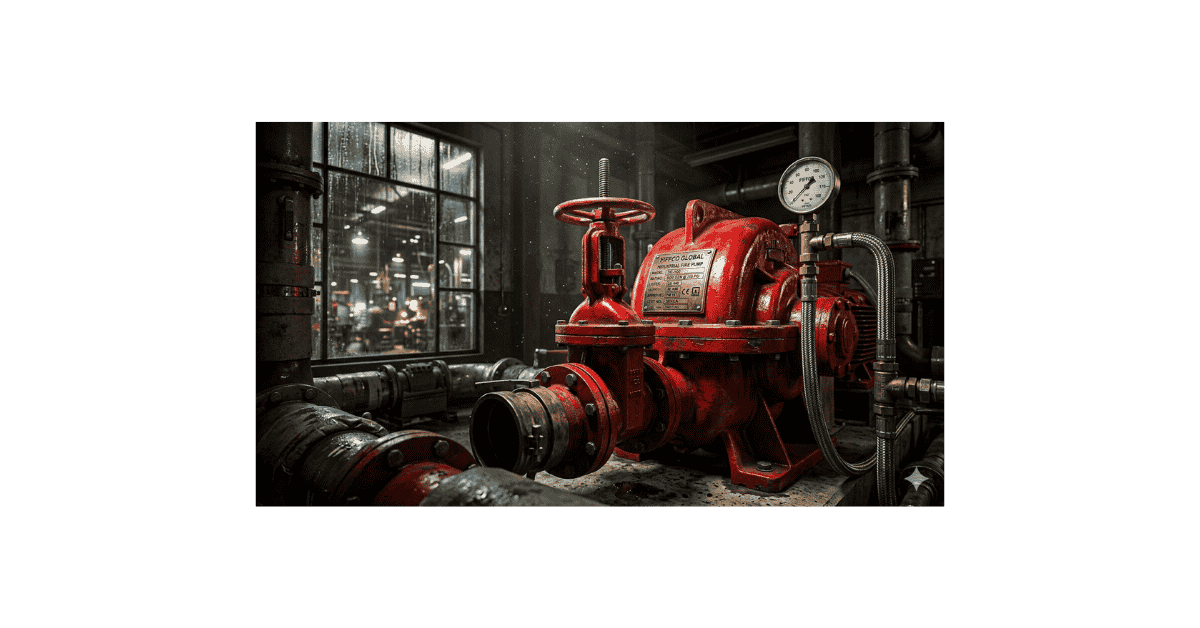
In many UK urban areas, the town main pressure is insufficient to meet the hydraulic demands of a large building. In these cases, we install a dedicated water storage tank and a set of fire pumps. These pumps ensure that even the highest sprinkler head on the top floor receives the required pressure ($bar$) and flow ($L/min$).
Explore our specialist fire pumps range to see the technology required for high-rise pressure maintenance.
4. Alarm Valves (Gong)
When water flows through the system, it triggers a mechanical water motor alarm gong on the outside of the building. This provides a fail-safe audible alert that does not rely on electricity.
5. System Types: Wet vs. Dry Pipe
- Wet Pipe: The most common. Pipes are always filled with water. Simple and reliable.
- Dry Pipe: Used in unheated spaces (like car parks) where water might freeze. The pipes are filled with pressurized air or nitrogen, which holds back the water until a head opens.
- Pre-Action: Requires two “triggers” (e.g., a smoke detector AND a sprinkler head opening) before water flows. Common in data centres to prevent accidental water damage.
Relevant Standards & Compliance (UK & International)
Navigating the legal landscape of fire protection in the UK requires a firm grasp of both local and international benchmarks.
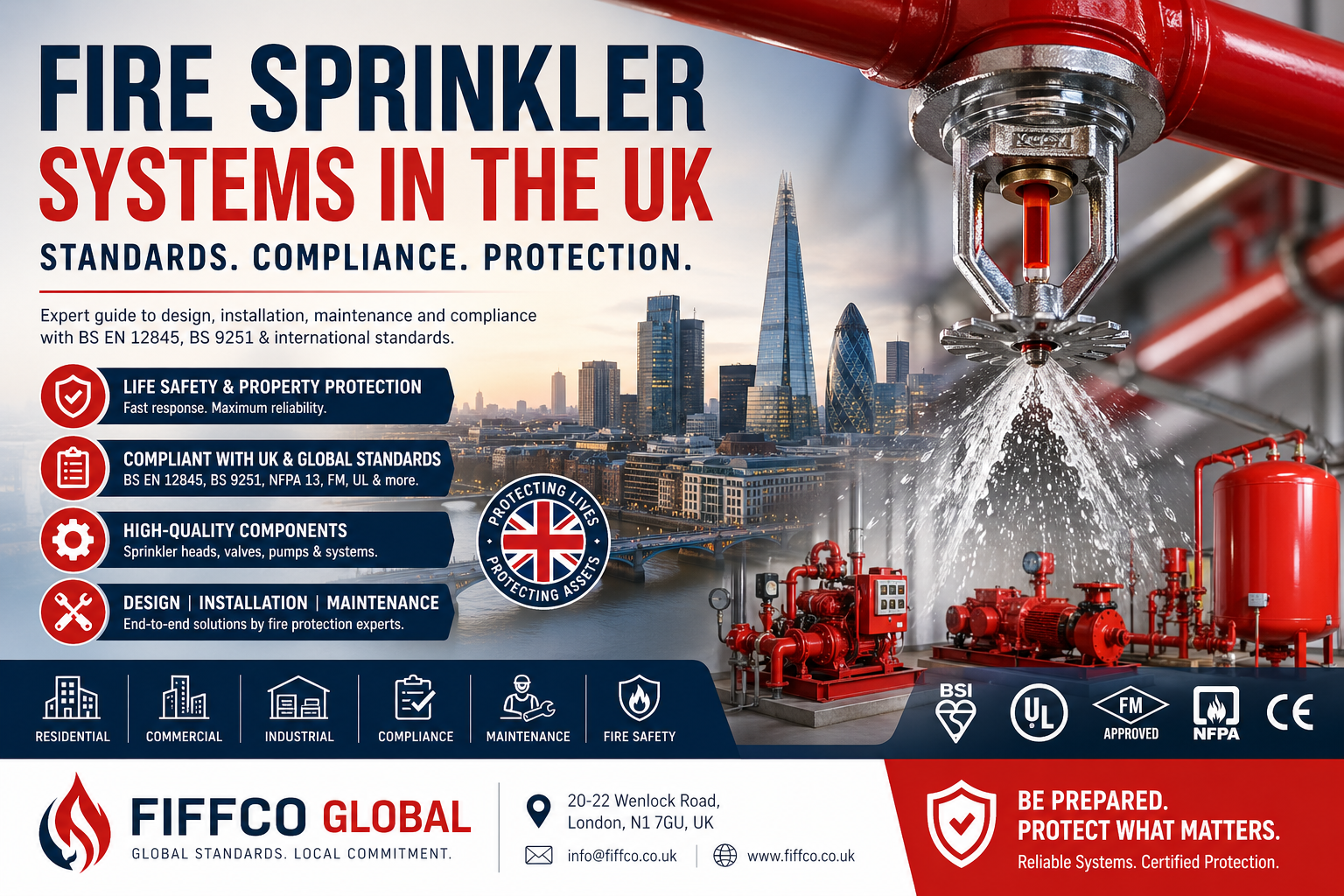
The primary standard for commercial sprinkler systems in the UK is BS EN 12845. This document dictates everything from the “Hazard Classification” (Light Hazard, Ordinary Hazard, or High Hazard) to the specific pipe sizing and water supply durations. For domestic and residential settings, BS 9251 is the governing standard.
However, because many UK-based multinational firms or high-risk industrial sites seek the highest possible levels of property protection, we often look toward international standards:
- NFPA 13: The global “gold standard” from the National Fire Protection Association (https://www.nfpa.org). It is often more prescriptive than British Standards and is frequently requested by insurers.
- FM Global Data Sheets: These are strictly for property loss prevention and are often more rigorous than local building codes.
- UL & FM Approvals: When selecting components, look for the UL (https://www.ul.com) or FM marks. These indicate that the equipment has undergone “live fire” testing and rigorous stress analysis.
Fiffco Global supplies sprinkler systems that comply with international standards — explore our fire protection valves range here: [https://fiffco.co.uk/fire-protection-valves].
Compliance isn’t just about avoiding fines; it’s about insurance validity. If a fire occurs and your system is found to be non-compliant with BS EN 12845, your insurer may have grounds to reduce or deny a payout.
How to Design, Install, and Maintain Your System — Step-by-Step
Installing a fire sprinkler system in the UK is a journey that starts at the drawing board and never truly ends, as maintenance is a lifetime commitment.
- Hazard Classification: Before a single pipe is cut, a fire safety engineer must determine the building’s hazard level. A warehouse storing plastics (High Hazard) requires significantly more water than a library (Ordinary Hazard).
- Hydraulic Calculations: Engineers use specialized software to ensure the pipe network can deliver the required density of water. This involves calculating friction loss across every elbow and tee in the system.
- Water Supply Verification: Conduct a flow test on the local water main. If the town main can’t provide the “Q” (flow) and “P” (pressure) needed, you must design a tank and pump house.
- Professional Installation: Pipes must be hung using approved brackets and spaced according to the specific “throw” of the sprinkler heads. DO: Ensure all installers are third-party accredited (such as FIRAS or LPCB).
- Commissioning and Testing: Once installed, the system undergoes a hydrostatic test (usually at 15 bar for two hours) to check for leaks. The alarm signals are then tested with the Fire Alarm Notification System.
- Routine Maintenance: Following BS EN 12845, systems require weekly, quarterly, and annual checks. DON’T: Forget to test your fire pump batteries weekly; a pump that won’t start is just an expensive piece of modern art during a fire.
Common Mistakes & How to Avoid Them
Even the most well-intentioned building owners fall into these traps.
- Changing Building Use Without Re-evaluating the System: We often see “Ordinary Hazard” systems in buildings that have been converted into “High Hazard” storage facilities. If you increase the fuel load (e.g., stacking pallets higher), the existing sprinkler system may be overwhelmed. Fix: Conduct a professional fire risk assessment whenever the building’s layout or purpose changes.
- Painting Over Sprinkler Heads: During renovations, decorators often spray-paint the ceiling, including the sprinkler heads. This coats the heat-sensitive bulb in an insulating layer, delaying or preventing activation. Fix: Replace any painted heads immediately; they cannot be cleaned effectively.
- Inadequate Clearance Below Heads: Storage is often piled right up to the ceiling. Sprinklers need at least 450mm to 900mm of clear space below the deflector to develop their spray pattern. Fix: Mark “No Storage” lines on walls to guide warehouse staff.
- Ignoring the Backflow Preventer: UK water regulations require that fire systems don’t allow “stagnant” water to flow back into the drinking water supply. Fix: Ensure a compliant backflow prevention device is installed and tested annually.
Real-World Applications & Scenario Analysis
Scenario A: The High-Rise Residential Complex
In a 20-storey residential tower in Manchester, a kitchen fire breaks out on the 14th floor. Without sprinklers, the fire could track up the external cladding or through internal voids. With a BS 9251 compliant system, a single head activates. It contains the fire to the room of origin, allowing the residents on the 15th floor to evacuate calmly via the protected stairwell, rather than facing a life-threatening “stay put” vs. “evacuate” dilemma.
Scenario B: The Logistics Distribution Centre
A massive 50,000 sq. ft. warehouse in the Midlands stores aerosol products. An accidental puncture leads to a fast-growing chemical fire. Because the facility uses an ESFR (Early Suppression Fast Response) system, the high-volume discharge suppresses the fire in its incipient stage. This prevents the “racking” from collapsing, saving millions in stock and preventing a multi-day closure of a critical supply chain node.
Frequently Asked Questions (FAQ)
Do fire sprinklers all go off at once like in the movies?
No, this is a common myth. Only the sprinkler heads directly exposed to the heat of the fire will activate. In 80% of fires, only one or two heads are needed to control the blaze, significantly minimizing water damage compared to a fire brigade hose.
Are fire sprinklers required by law in the UK?
Yes, in specific circumstances. For example, since 2020, new-build residential buildings in England over 11 metres in height must be fitted with sprinklers. Requirements differ slightly in Scotland and Wales, where regulations are often stricter for domestic properties.
Will a fire sprinkler system cause excessive water damage?
While any water in a building is a concern, a fire sprinkler head typically discharges about 60–100 litres per minute. A fire department hose, by comparison, can discharge over 1,000 litres per minute. By stopping the fire early, sprinklers actually reduce total water damage.
[H3] How often do I need to service my fire sprinkler system?
Under BS EN 12845, certain checks are weekly (like fire pump starts), while others are quarterly or annual. An annual “full service” by a qualified technician is the minimum requirement for insurance compliance and to ensure the system’s mechanical integrity.
Can I use a fire sprinkler system to protect my computer server room?
While you can, most engineers recommend a gas suppression system. These “clean agent” systems extinguish fires using gas, leaving no residue and causing zero damage to sensitive electronics, unlike water-based sprinklers.
Why Choose Fiffco Global for Sprinkler Systems?
When it comes to life safety, there is no room for “good enough.” At Fiffco Global, we operate at the intersection of British engineering excellence and global manufacturing standards. Based at 20-22 Wenlock Road, London, we serve as a vital link for contractors and facility managers who require certified, high-performance fire fighting equipment.
Our portfolio isn’t just a list of products; it is a catalog of trust. Every component we trade or manufacture—from the smallest sprinkler head to the largest industrial fire pumps—carries the weight of international certifications. Whether it’s UL, FM, VdS, CE, or NFPA, our products meet the most rigorous testing protocols on the planet.
We understand that fire safety is a global challenge. That is why we have developed a robust supply chain capable of delivering critical life-safety components to projects across the UK, Europe, the Middle East, and beyond. We don’t just sell equipment; we provide the peace of mind that comes from knowing your building is protected by world-class technology.
Explore our full range of sprinkler systems at https://fiffco.co.uk/sprinkler-systems or contact our technical team today at info@fiffco.co.uk to discuss your specific project requirements.
Conclusion
A fire sprinkler system in the UK is far more than a collection of pipes and water; it is a silent sentry that guards lives and livelihoods 24 hours a day. By understanding the importance of BS EN 12845 compliance, choosing the correct system type—whether wet, dry, or pre-action—and committing to a rigorous maintenance schedule, you are making the ultimate investment in safety.
Remember, the most expensive fire sprinkler system is the one that fails to work when it’s needed most. Avoid common pitfalls like ignoring “No Storage” zones or skipping weekly pump tests. Instead, partner with experts who prioritise quality and certified performance.
If you are ready to upgrade your building’s fire strategy or need to source high-specification valves, pumps, or heads, we are here to help. Contact Fiffco Global today or browse our latest blog for more insights into the world of professional fire protection. Let’s build a safer future, one floor at a time.