


Published: April 2026 | Last Updated: April 2026 Author: Fiffco Global Technical Team | Reviewed by: Fire Safety Engineering Specialist
Introduction
Imagine a high-rise residential block in the heart of Manchester. At 2:00 AM, a small electrical fire breaks out in a third-floor hallway. Within minutes, smoke—the silent killer in most fire incidents—begins to fill the corridor. In this scenario, the difference between a manageable incident and a tragedy isn’t just the response time of the fire service; it is the integrity of a single fire door. If that door is propped open, damaged, or poorly maintained, it becomes a gateway for disaster rather than a barrier for life.
The landscape of fire safety in Britain has undergone a seismic shift following the tragic events of the last decade. As we navigate through 2026, the Fire Door Regulations UK 2026 framework has become more stringent than ever. For facility managers and building owners, “doing your best” is no longer a legal or ethical defense. Compliance is now measured in documented proof, rigorous inspection cycles, and the absolute reliability of hardware.
This article serves as your definitive roadmap for navigating these updated requirements. Whether you are managing a heritage office building in London or a modern industrial complex, understanding the nuances of current legislation is vital. We will break down the technicalities of Regulation 10, explain the difference between FD30 and FD60 ratings, and provide actionable steps to ensure your property remains a safe environment.
By the end of this guide, you will have a clear understanding of your legal responsibilities and the technical benchmarks required to meet UK safety standards. We have distilled a decade of fire safety engineering experience into this resource to ensure you move from confusion to total compliance.
What Are Fire Door Regulations UK 2026? (Definitions & Overview)
At its core, a fire door is much more than a heavy slab of timber or steel. It is a complex, engineered safety device designed to perform two critical functions: to provide a sealed barrier against smoke and flame, and to allow for a safe means of escape. Under the Fire Door Regulations UK 2026, which build upon the Fire Safety (England) Regulations 2022 and the Building Safety Act, the definition of a compliant door now encompasses the entire “door set”—including the frame, hinges, glazing, and seals.
Technically, fire doors work through “compartmentation.” By dividing a building into fire-resistant zones, these doors prevent the spread of fire from its point of origin to other areas. This buys precious time—typically 30 or 60 minutes—for occupants to evacuate and for fire-fighting teams to intervene. In 2026, the focus has shifted heavily toward the “Golden Thread” of information, meaning every door must have a traceable history of its manufacture and maintenance.
These regulations apply across virtually all non-domestic environments, including:
- Residential Buildings: Specifically multi-occupied residential buildings over 11 metres in height.
- Commercial Offices: Ensuring protected escape routes are maintained.
- Healthcare & Education: Where “defend-in-place” strategies often rely on high-performance fire doors.
- Industrial Facilities: Protecting high-value assets and hazardous zones.
Failure to comply doesn’t just risk property; it carries the threat of unlimited fines and even imprisonment for Responsible Persons (RPs) who neglect their duties under the Regulatory Reform (Fire Safety) Order 2005.
Key Components of a Compliant Fire Door Assembly
A fire door is only as strong as its weakest link. To meet the Fire Door Regulations UK 2026, each component must be tested together as a unified system.
The Door Leaf and Core
The leaf is the main body of the door. Most UK fire doors are rated as FD30 (30 minutes) or FD60 (60 minutes). These are usually constructed with a solid core of flaxboard, particleboard, or solid timber. Pro Tip: Never plane the edges of a fire door leaf beyond the manufacturer’s specified limits, as this can expose the core and compromise fire resistance.
Intumescent Seals
These are strips chemically designed to expand when exposed to heat above 200°C. When they expand, they seal the gap between the door and the frame, preventing the passage of fire. Many modern doors use “combined” seals that also incorporate a brush or rubber fin to stop cold smoke, which is often more lethal than the flames themselves.
Fire-Rated Hardware (Ironmongery)
Hinges, locks, and closers must be CE or UKCA marked and compatible with the door’s fire rating. For instance, if you use a non-fire-rated hinge on an FD60 door, the door may sag or drop during a fire, breaking the intumescent seal. Example: In a recent audit of a retail chain, we found that several fire doors had been fitted with standard “home-store” hinges. Under intense heat, these would have melted, causing the door to fail in under 10 minutes.
Self-Closing Devices
A fire door is useless if it is open. Every fire door (except those to cupboards and service risers) must be fitted with an automatic self-closing device. This ensures that even if someone flees a room and forgets to close the door, the mechanical closer will pull it shut into the frame.
Relevant Standards & Compliance (UK & International)
Compliance is not a matter of opinion; it is a matter of certification. In the UK, fire doors are governed by several rigorous standards that align with international best practices.
- BS 476-22 & BS EN 1634-1: These are the primary testing standards. BS EN 1634-1 is the more modern European standard, involving more rigorous pressure testing than the older British Standard.
- Regulation 10 (Fire Safety England Regulations): This mandates that for residential buildings over 11m, fire doors in common areas must be inspected quarterly, and flat entrance doors must be checked annually on a “best endeavour” basis.
- NFPA 80 (USA/International): While UK-based, many of our global clients follow the National Fire Protection Association standards for the installation and maintenance of fire doors and windows.
- UL & FM Approvals: These international certifications from Underwriters Laboratories and FM Approvals (External links open in new tab) provide an extra layer of assurance that the equipment has been tested under extreme conditions.
For contractors and engineers, using certified products is the only way to mitigate liability. Fiffco Global supplies fire protection equipment that complies with these international standards—explore our products overview range here to see how we support global safety.
How to Install and Maintain Fire Doors: A Step-by-Step Guide
Maintaining compliance with Fire Door Regulations UK 2026 requires a proactive, documented approach. Follow this consultant-led guide for your facility.
- Verify Certification: Before installation, check the “fire label” on the top or hinge edge of the door. This confirms its rating and manufacturer.
- Gap Assessment: Use a gap gauge to ensure the space between the door leaf and the frame is consistently between 2mm and 4mm. DON’T use standard wood filler to close gaps; if the gap is too large, the frame must be reset or the door replaced.
- Seal Inspection: Ensure intumescent strips are continuous and not painted over. Paint can prevent the chemical reaction required for the seal to expand.
- Hinge Check: Ensure there are at least three fire-rated hinges, all screws are present, and there is no “black dust” (oil leakage), which indicates mechanical wear.
- Closing Speed: Test the self-closer. The door should close reliably from any angle and “latch” into the frame without slamming so hard it causes damage. DO ensure the door can be opened easily by vulnerable occupants—the closing force must be balanced with accessibility needs.
- Documentation: Record every inspection in a digital logbook. Under current UK law, if an inspection isn’t documented, it effectively didn’t happen.
Common Mistakes & How to Avoid Them
Even with the best intentions, safety managers often fall into these common traps:
- Propping Doors Open: This is the most frequent violation. Staff often use wedges or fire extinguishers to keep doors open for ventilation. Fix: Install electromagnetic hold-open devices linked to the fire alarm system, which release the door automatically upon detection.
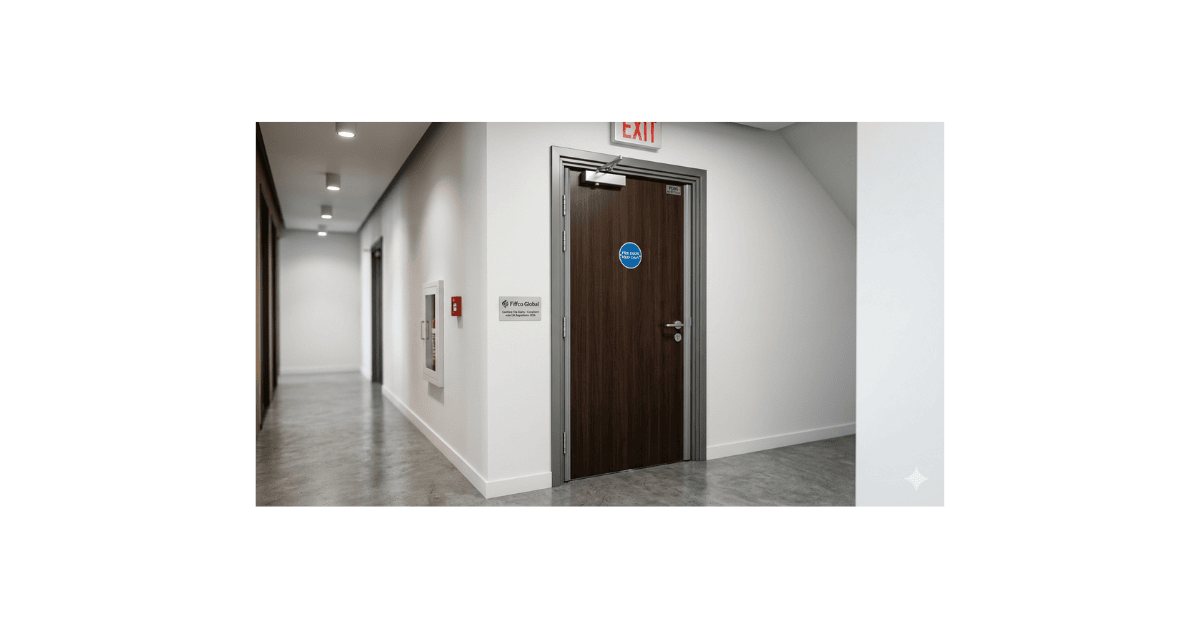
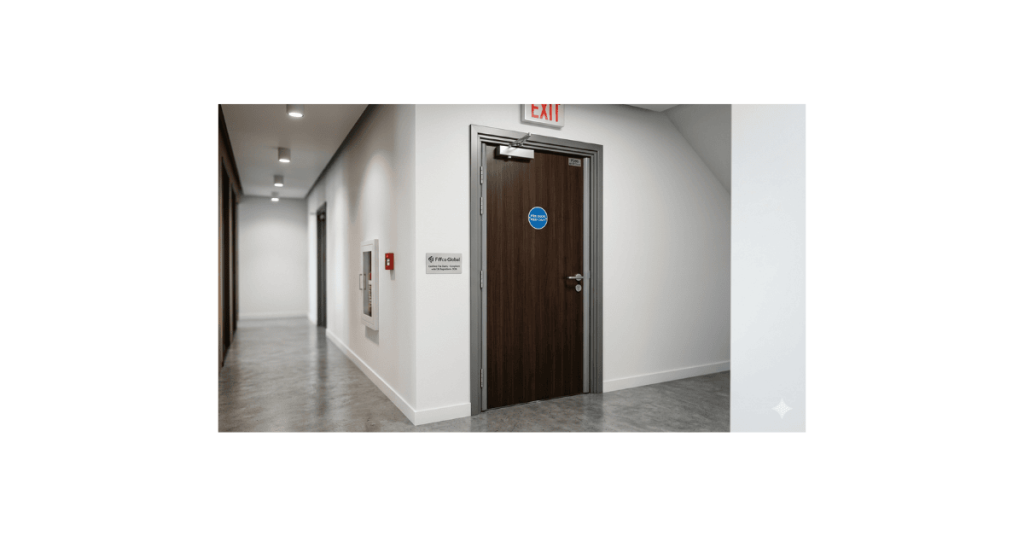
- Incorrect Signage: Fire doors must have the correct blue “Fire Door Keep Shut” or “Fire Door Keep Locked” signage at eye level. Omitting this is an automatic fail during a Fire Risk Assessment (FRA).
- Unauthorised Modifications: Cutting in new vision panels or installing “smart” locks that aren’t fire-rated. This voids the door’s certification. Always consult the manufacturer before making any hardware changes.
- Neglecting the Frame: Many people replace the door but keep the old, non-fire-rated frame. A fire-rated door in a standard timber frame will fail as the frame burns away around it.
Real-World Applications: Residential vs. Commercial
Scenario 1: The High-Rise Residential Complex In a 15-storey apartment block in London, the Responsible Person must now adhere to the quarterly inspection rule for common area doors. We recently advised a client who discovered that 40% of their flat entrance doors had been modified by tenants (e.g., adding cat flaps). Under Fire Door Regulations UK 2026, the RP had to implement a replacement program to restore the building’s fire compartmentation, as those modified doors no longer met the FD30 standard.
Scenario 2: The Industrial Warehouse A large distribution centre uses heavy-duty steel fire doors to separate the loading bay from the main office. Because of high traffic, the hinges were wearing out every six months. We recommended moving to high-cycle, grade 14 fire-rated hinges and installing sprinkler systems to provide additional cooling to the door surfaces, extending the life of the assets and improving safety.
Frequently Asked Questions (FAQ)
Does every door in my building need to be a fire door?
No. Fire doors are required where a wall is designated as a fire-separating element, such as stairwells, corridors, and doors leading into boiler rooms. Your Fire Risk Assessment (FRA) will identify exactly which doors must be fire-rated.
Can I paint a fire door?
Yes, but you must avoid painting over the intumescent seals or the hardware. Use regular decorative paint; “fire-rated paint” is usually unnecessary for the door leaf itself unless it is a specific requirement to reduce flame spread on the surface.
How often should fire doors be inspected?
In residential buildings over 11m, common area doors need a check every three months. For most commercial buildings, a thorough six-monthly inspection is considered best practice, though high-traffic areas may require monthly checks.
What is the difference between FD30 and FD30S?
The ‘S’ stands for smoke. An FD30S door has been tested for smoke leakage and includes smoke seals (usually brushes or fins). In most UK regulations, particularly for escape routes, the ‘S’ rating is mandatory.
Can I repair a damaged fire door?
Minor repairs to the surface are sometimes possible, but any damage to the core, the hinges, or the seals usually necessitates a replacement to guarantee performance. Always refer to the manufacturer’s data sheet.
Why Choose Fiffco Global for Fire Protection?
At Fiffco Global, we understand that fire safety is a matter of precision and trust. Based at 20-22 Wenlock Road, London, we operate as a leading manufacturer and trader of high-performance fire-fighting equipment. Our team brings decades of engineering expertise to every project, ensuring that your facility isn’t just compliant on paper, but truly safe in practice.
Our products carry the world’s most prestigious certifications, including UL, FM, VdS, CE, and NFPA. This global recognition means that whether you are installing fire pumps or gas suppression systems, you are receiving equipment that has been tested against the most rigorous standards in the industry.
We don’t just sell products; we provide solutions. Our global supply chain ensures that even the most complex industrial or commercial projects receive the equipment they need, on time and to specification. We are committed to innovation, constantly updating our range to meet the evolving demands of the UK and international fire safety markets.
Explore our full range of fire protection solutions at https://fiffco.co.uk/products or contact our technical team at info@fiffco.co.uk for expert advice on your next project.
Conclusion
Navigating the Fire Door Regulations UK 2026 can feel like a daunting task, but it is a cornerstone of modern life safety engineering. By focusing on the “door set” as a whole, maintaining a rigorous inspection schedule, and refusing to compromise on certified hardware, you can protect both your occupants and your legal interests.
The three key takeaways for 2026 are:
- Certification is King: Never install a door or component without traceable fire-rating data.
- Inspection is Mandatory: Regulation 10 has changed the frequency of checks; ensure your logbooks are up to date.
- Hardware Matters: A fire door is only as good as its closer, hinges, and seals.
Don’t leave your building’s safety to chance. Whether you need to upgrade your fire extinguishers or design a full suppression system, Fiffco Global is here to help. Contact us today to ensure your property meets the highest standards of fire safety.