


Published: April 2026 | Last Updated: April 2026 Author: Fiffco Global Technical Team | Reviewed by: Fire Safety Engineering Specialist
Introduction
— Hook + Context Imagine a quiet Tuesday afternoon in a busy commercial kitchen. A pan of oil catches fire. A well-meaning staff member grabs a nearby water extinguisher—the most common type they recognise—and aims. In seconds, what was a manageable grease fire erupts into a massive fireball as the water causes the oil to splash and ignite everything in its path. This isn’t a hypothetical horror story; it is a reality that occurs in facilities where the wrong equipment is matched to the wrong risk.
In the UK alone, fire and rescue services attend thousands of non-residential fires every year. A significant portion of these could be suppressed in their infancy if the correct first-aid firefighting equipment were available and used correctly. The problem isn’t usually a lack of extinguishers; it is a lack of the right types of fire extinguishers for the specific hazards present in the building.
This article is designed to cut through the confusion. Whether you are a facilities manager overseeing a high-rise office block or a procurement officer for a petrochemical plant, we will provide you with the technical clarity needed to make informed decisions. We will move beyond basic “red cylinder” descriptions to explore the science of suppression, ensuring your life safety strategy is robust and compliant.
By the time you finish reading, you will understand the nuances of fire classes, the technical differences between suppression agents, and the exact steps required to maintain a compliant, safe environment. You aren’t just buying hardware; you are investing in the most critical few seconds of an emergency.
What Are Fire Extinguishers? (Definitions & Overview)
In technical terms, a fire extinguisher is a first-aid fire suppression device designed to discharge a “medium” or “agent” to extinguish or control a small fire. It is important to note the phrase “small fire.” These devices are not intended to fight out-of-control conflagrations; they are meant to prevent a localized ignition from becoming a catastrophic event.
The mechanics of an extinguisher rely on disrupting the Fire Tetrahedron: heat, fuel, oxygen, and the chemical chain reaction. Different agents target different parts of this tetrahedron. For instance, water cools the fuel (removing heat), while Carbon Dioxide (CO2) displaces oxygen. A dry powder extinguisher interrupts the chemical reaction itself.
These devices are essential in almost every built environment, from residential hallways to industrial engine rooms. In high-risk facilities, they serve as the bridge between fire detection and the activation of large-scale systems like sprinkler systems or the arrival of the fire brigade.
For life safety, extinguishers provide a means of escape. For property protection, they minimize the downtime and damage that follows even a small fire. However, their effectiveness is entirely dependent on the user’s ability to identify the “Class” of fire they are facing and use the appropriate medium.
Key Types of Fire Extinguishers and How They Work
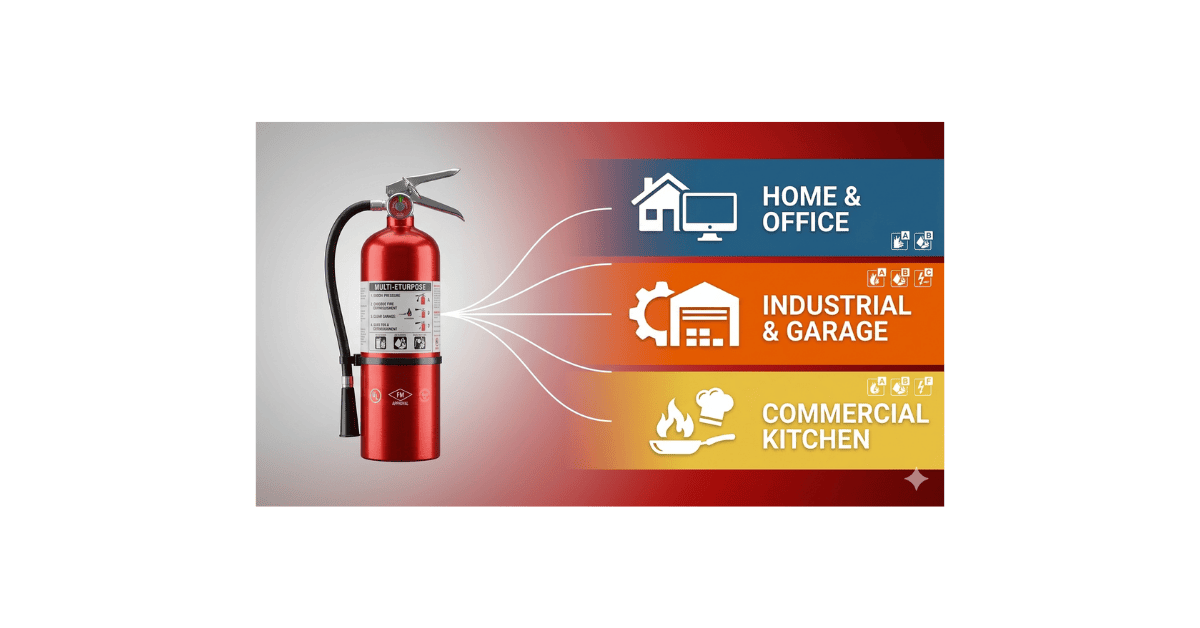
Understanding the “Class” system is the first step. In the UK and Europe, fires are categorized from A to F based on the fuel source. Using the wrong agent—such as water on an electrical fire—can be fatal.
Water Extinguishers (Class A)
Water remains the standard for Class A fires involving solid organic materials like wood, paper, and textiles. It works primarily through cooling. Modern variants include “Water Additive” extinguishers, which use chemicals to reduce the surface tension of the water, allowing it to soak into fabrics more effectively. Pro Tip: Always check if your water extinguisher is “dielectric tested” if it is located near electrical sockets, though they should generally be avoided for live electrical risks.
Foam (AFFF) Extinguishers (Class A & B)
Aqueous Film Forming Foam (AFFF) is a versatile medium. It cools the fire and creates a “blanket” over flammable liquids (Class B), preventing oxygen from reaching the fuel and suppressing vapours. These are common in garages and warehouses. In a real-world scenario, if a small petrol spill ignites on a workshop floor, the foam blanket prevents the fire from spreading by sealing the liquid surface.
Carbon Dioxide (CO2) Extinguishers (Class B & Electrical)
CO2 is a non-conductive gas that leaves no residue. It is the primary choice for electrical fires because it won’t damage sensitive servers or switchgear. It works by displacing oxygen. However, it has very little cooling effect, meaning re-ignition is a risk once the gas dissipates. Pro Tip: CO2 extinguishers feature a “frost-free” horn in modern designs, but users must still be careful not to touch the discharge pipe to avoid freeze burns.
Dry Powder Extinguishers (Class A, B, C & Electrical)
Often called “ABC” extinguishers, dry powder is the multi-purpose workhorse. It is highly effective at knocking down flames quickly. However, the powder is messy and can obscure vision or cause respiratory irritation in confined spaces. For this reason, the UK’s Health & Safety Executive (HSE) often recommends against their use in indoor office environments unless specifically required.
Wet Chemical Extinguishers (Class F & A)
Specifically designed for commercial kitchens, wet chemical agents react with burning cooking oil to create a thick, soapy film—a process called saponification. This seals the surface and cools the oil simultaneously. This is the only safe way to handle deep-fat fryer fires.
Relevant Standards & Compliance (UK & International)
Compliance isn’t just about passing an inspection; it’s about ensuring the equipment performs under pressure. In the UK, the primary standard for the manufacture and testing of extinguishers is BS EN3. This standard dictates the colour coding (red bodies with a specific colour zone for the agent type) and the performance ratings.
International projects often look toward NFPA 10 (Standard for Portable Fire Extinguishers), which provides rigorous guidelines on placement, mounting heights, and travel distances. For those operating in the marine or offshore sectors, VdS and MED (Marine Equipment Directive) certifications are often mandatory.
At Fiffco Global, we understand that building owners and contractors face immense pressure to meet these regulations. Using uncertified equipment can void insurance policies and lead to legal liability in the event of an injury. Fiffco Global supplies fire extinguishers that comply with international standards including UL, FM, and CE—explore our full range here: [https://fiffco.co.uk/fire-extinguishers].
Beyond the hardware, the British Standards Institution (BSI) provides BS 5306, which covers the installation and maintenance of portable extinguishers. This standard requires that a “competent person” performs an annual service to ensure the pressure gauges are accurate and the agent has not settled or degraded.
How to Choose, Install, and Maintain Fire Extinguishers — Step-by-Step
Selecting and managing your fire safety equipment requires a methodical approach. Follow this guide to ensure your facility remains compliant.
- Conduct a Fire Risk Assessment (FRA): Identify what is burning. Do you have more paper (Class A) or more electronics (Electrical)? Your extinguisher choice must match your highest risks.
- Calculate Travel Distances: According to BS 5306, you should generally not have to travel more than 30 metres to reach a Class A extinguisher. For higher risks like Class B or C, this distance is often reduced.
- Mounting and Visibility: Extinguishers should be mounted on walls at a height where the handle is roughly 1 metre to 1.5 metres from the floor. DO ensure that every extinguisher is accompanied by a clear ID sign explaining its type and use.
- Commissioning Upon Delivery: Just because an extinguisher is new doesn’t mean it is ready. A technician must commission it on-site to ensure it wasn’t damaged during transit.
- Monthly Visual Inspections: Check that the pressure needle is in the “green” zone, the safety pin is intact, and the nozzle is free of obstructions like spider webs or dust.
- Professional Annual Servicing: Hire a certified engineer to perform a basic service every 12 months. They will check the internal weight, seals, and hose integrity.
- Extended Service or Replacement: Most water and foam extinguishers require a “discharge test” every 5 years, while CO2 units require a hydraulic pressure test every 10 years. DON’T simply leave an extinguisher on the wall for a decade without professional testing; the internal agent can solidify and fail when needed.
Common Mistakes & How to Avoid Them
Even with the best intentions, we see many facilities managers make critical errors that compromise safety.
- Using Multi-Purpose Powder in Small Offices: While “ABC” powder is effective, the cloud it creates in a small, windowless office can cause total disorientation. The fix: Use a combination of Water/Foam and CO2 for indoor office environments to maintain visibility.
- Assuming One Size Fits All: A common mistake is buying twenty 6kg powder extinguishers because it’s easier for procurement. However, if you have a kitchen area, those powder units are useless against a fat fire. The fix: Diversify your inventory based on the specific room hazards.
- Obstructing Access: We often see extinguishers hidden behind coats, filing cabinets, or propped-open fire doors. If a fire starts, you don’t have time to play hide-and-seek. The fix: Use floor stands or clearly marked “Fire Points” that remain clear of all furniture.
- Neglecting the “Service Gap”: Many owners assume that because the gauge is in the green, the unit is fine. Gauges can sometimes get stuck or “seize.” The fix: Ensure the annual service includes a physical check of the valve mechanism and weight.
Real-World Applications / Case Study
Angle To better understand how these choices play out, let’s look at two distinct environments.
Scenario 1: The Modern High-Rise Commercial Office
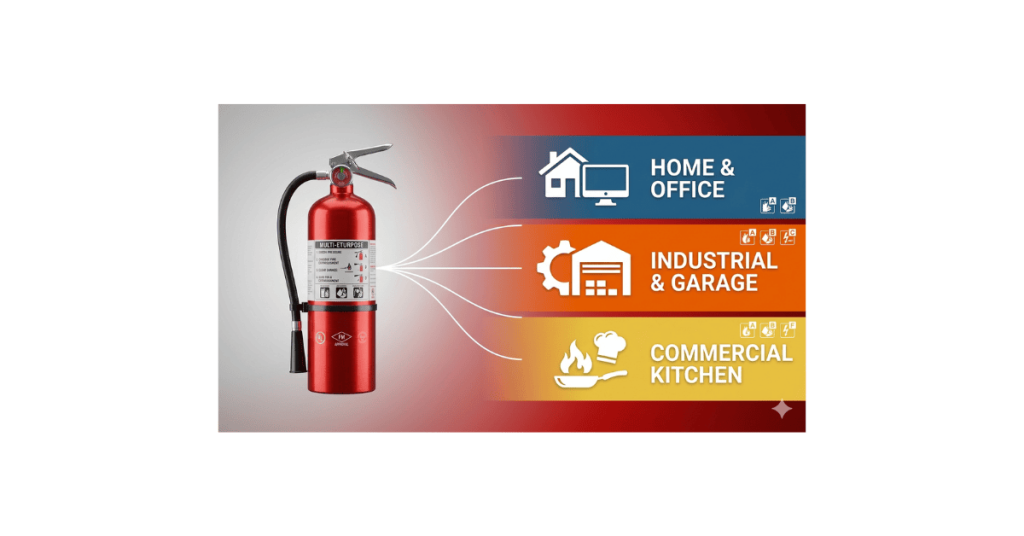
In a London-based high-rise, the primary risks are electrical equipment (computers, servers) and organic materials (desks, carpets). A blanket installation of Dry Powder would be a mistake due to the potential for damage to expensive server racks and the mess created during a false alarm. Instead, the “Gold Standard” here is a pairing: a 6-litre Water Mist or Foam extinguisher for Class A risks and a 2kg or 5kg CO2 extinguisher for the electrical points. This ensures that if a monitor catches fire, it can be put out without ruining every other computer in the room.
Scenario 2: The Petrochemical Processing Plant
Here, the risks are significantly higher, involving large volumes of flammable liquids and gases. Portable extinguishers are the first line of defence before the foam suppression system activates. In this environment, high-capacity 9kg Dry Powder units and large wheeled Foam units are essential. These are chosen for their high “fire rating” (their ability to extinguish a larger volume of fire) and their ability to be used outdoors where wind might disperse a lighter gas like CO2.
Frequently Asked Questions (FAQ)
Can I use one extinguisher for all types of fires?
No, there is no single “universal” extinguisher. While ABC Dry Powder covers many classes, it is dangerous on Class F (cooking oil) fires and can be problematic in confined spaces. You must match the extinguisher to the specific fire classes present in your risk assessment.
How often do fire extinguishers need to be replaced?
Most extinguishers have a usable lifespan of 10 to 15 years, provided they are serviced annually. However, foam and water units typically need a “refresh” or discharge test every 5 years, while CO2 units require a factory overhaul and pressure test every 10 years.
What does the number before the “A” or “B” mean on the label?
This is the fire rating. For example, a “13A” rating means the extinguisher can tackle a wood crib fire of a specific size in test conditions. A “55B” rating indicates its capacity for flammable liquid fires. Higher numbers mean more extinguishing power.
Is it legal to have fire extinguishers without a service label?
In a commercial or public-access building, failing to have serviced and labelled extinguishers is a breach of the Regulatory Reform (Fire Safety) Order 2005. It can lead to heavy fines, prosecution, and the invalidation of your insurance.
Why are CO2 extinguishers so loud?
CO2 is stored under high pressure as a liquid. When discharged, it expands rapidly into a gas, creating a loud “roaring” sound. This can be startling, so it is important that staff are trained on what to expect during fire safety drills.
Why Choose Fiffco Global for Fire Extinguishers?
When it comes to life safety, there is no room for “good enough.” Fiffco Global is a UK-based manufacturer and trader headquartered in London, dedicated to providing high-performance fire fighting equipment to a global market. Our products are not just “compliant”; they are engineered to exceed the rigorous standards set by UL, FM Approvals, and VdS.
We understand that a fire extinguisher is a small part of a much larger ecosystem. That is why we offer a comprehensive range of products, from fire hydrants to complex clean agent systems. Our global supply chain ensures that whether you are fitting out a warehouse in Dubai or an office in London, you receive the same high-quality, certified equipment.
Our commitment to innovation means we stay ahead of changing regulations, helping you navigate the complexities of international fire codes like NFPA. We don’t just sell boxes; we provide the technical expertise required to ensure your building is a safe place to work and live.
Explore our full range of fire extinguishers at https://fiffco.co.uk/fire-extinguishers or contact our team at info@fiffco.co.uk for a tailored consultation.
Conclusion
Choosing the right types of fire extinguishers is a fundamental responsibility for any building owner or manager. As we have explored, the difference between a minor incident and a total loss often comes down to having the correct agent—whether it’s CO2 for your electronics, Foam for your fuel, or Wet Chemical for your kitchen.
Remember the three pillars of portable fire safety:
- Correct Specification: Matching the agent to the fire class.
- Strategic Placement: Ensuring extinguishers are visible and accessible.
- Rigorous Maintenance: Never skipping an annual service.
Fire safety is an evolving field, but the goal remains the same: protecting lives and property. By investing in certified equipment and staying informed on standards like BS EN3 and NFPA 10, you are building a culture of safety.
If you have questions about your specific facility or need to upgrade your current equipment, we invite you to contact us or browse our blog for more technical guides. Stay safe, stay compliant, and ensure your team is always prepared for the unexpected.