





Published: April 2026 | Last Updated: April 2026 Author: Fiffco Global Technical Team | Reviewed by: Fire Safety Engineering Specialist
Introduction
Imagine a fire breaking out on the tenth floor of a modern commercial complex or deep within a sprawling industrial warehouse. While portable extinguishers are vital for the first few seconds of an incident, they are no match for a fully developed structural fire. When the Fire and Rescue Service (FRS) arrives, their ability to save the building—and the lives within it—depends almost entirely on one thing: a reliable, high-pressure water supply delivered through a fire hydrant system.
According to UK fire statistics, the speed of intervention is the single biggest factor in reducing property damage. However, we often speak with facility managers who view their external hydrants as “set and forget” infrastructure. This is a dangerous misconception. A seized valve or a blocked pipe can turn a manageable incident into a total loss in minutes.
The problem many professionals face is navigating the dense forest of British Standards (BS), local building regulations, and equipment specifications. Whether you are a building contractor or a safety manager, you need to know that your system will perform under pressure. This article solves that complexity by breaking down the technical mechanics, the legal requirements in the UK, and the practical maintenance steps you must take to remain compliant.
By the end of this guide, you will understand exactly how these systems function, the difference between wet and dry mains, and how to ensure your site meets the rigorous standards set by bodies like the British Standards Institution (BSI) (opens in new tab).
What Is a Fire Hydrant System? (Definitions & Overview)
In the simplest terms, a fire hydrant system is an engineered network of pipes, valves, and outlets designed to provide a high-capacity water supply for firefighting. While a domestic tap might provide a few litres per minute, a professional hydrant system is designed to deliver thousands of litres, allowing firefighters to connect their hoses directly to a pressurised source.
Technically, the system works by tapping into a reliable water source—typically the municipal water main, a dedicated fire water tank, or a natural source like a lake or river. When a fire occurs, firefighters use a “standpipe” to connect to the hydrant. This water is then either used directly or pumped through a fire engine to increase pressure before being directed into the building or onto the blaze.
These systems are non-negotiable for:
- High-rise residential and commercial buildings where fire engines cannot reach upper floors.
- Large industrial estates where the distance from the road to the centre of the site is too great for standard hose reels.
- Hospitals and educational campuses where life safety risks are exceptionally high.
Beyond just putting out flames, a well-designed hydrant system acts as a “force multiplier” for the fire service. It ensures that firefighters don’t waste precious minutes laying kilometres of hose back to a distant water source. In the world of life safety engineering, the hydrant system is the backbone of the entire fire suppression strategy.
Key Components & How the System Works
A fire hydrant system is only as strong as its weakest link. To ensure reliability, each component must be manufactured to withstand high pressure and environmental degradation.
The Hydrant (Underground and Pillar)
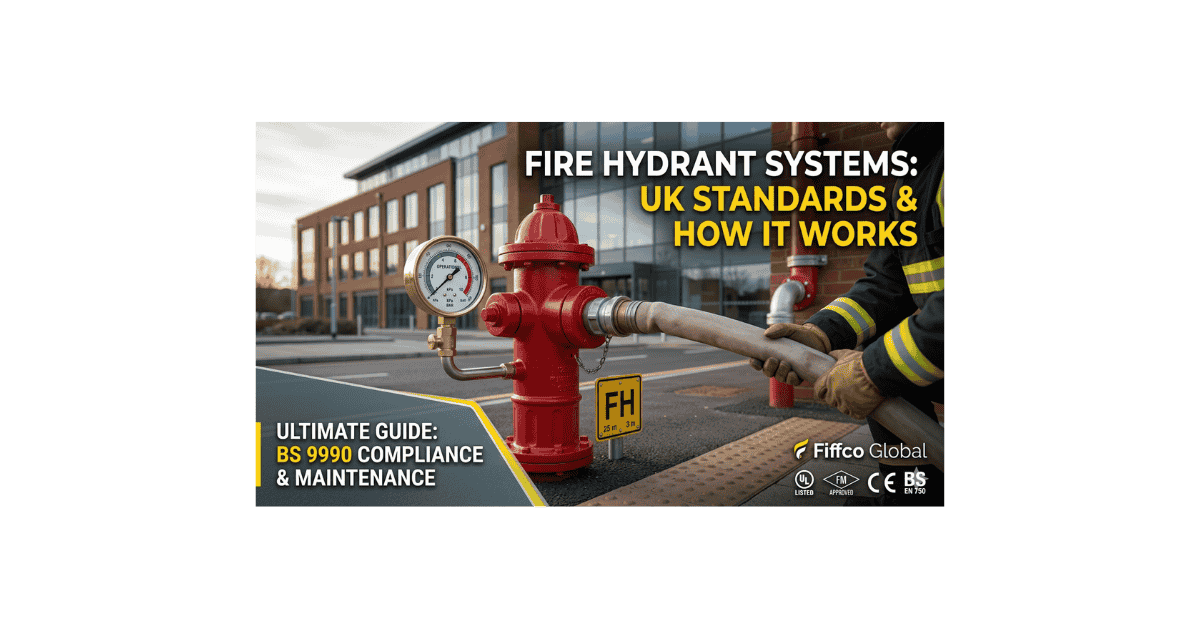
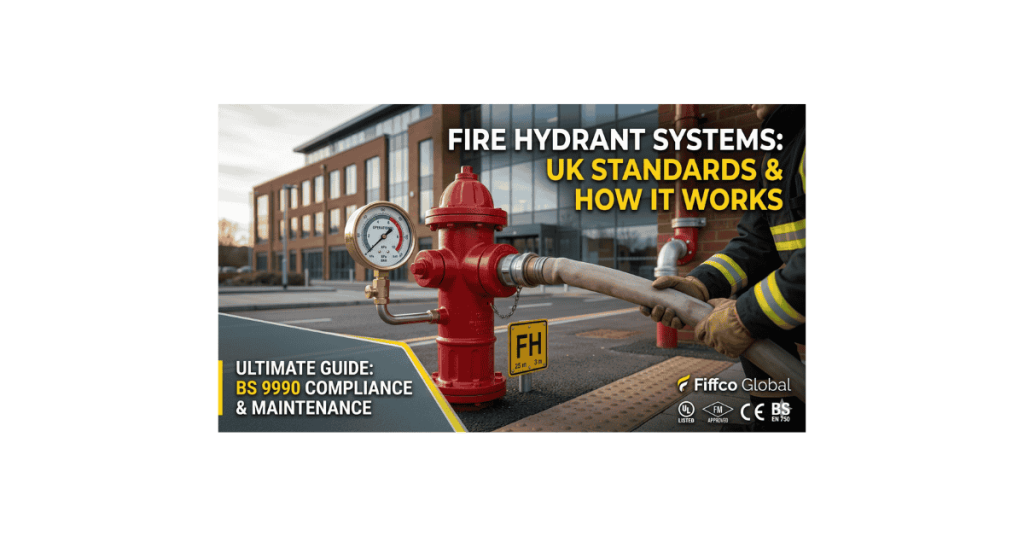
In the UK, the most common type is the underground fire hydrant, usually identified by a “FH” sign and a yellow cover. In many international markets, the pillar hydrant (the iconic red post) is preferred. Both serve the same purpose: providing a connection point for the fire service.
- Real-world example: In a busy London retail park, underground hydrants are used to prevent vehicle damage and save space, while a pillar hydrant might be used in a fenced industrial yard for immediate visibility.
Fire Protection Valves
Valves are the “traffic controllers” of the system. Isolating valves allow for maintenance without shutting down the entire network, while non-return (check) valves ensure that water doesn’t flow back into the town’s clean water supply. You can explore our full range of Fire Protection Valves to see how these manage system integrity.
Pro Tip: Always ensure your valves are “indicating” types (like OS&Y or butterfly valves with monitors), so you can tell at a glance if the system is open or closed.
Fire Pumps and Tanks
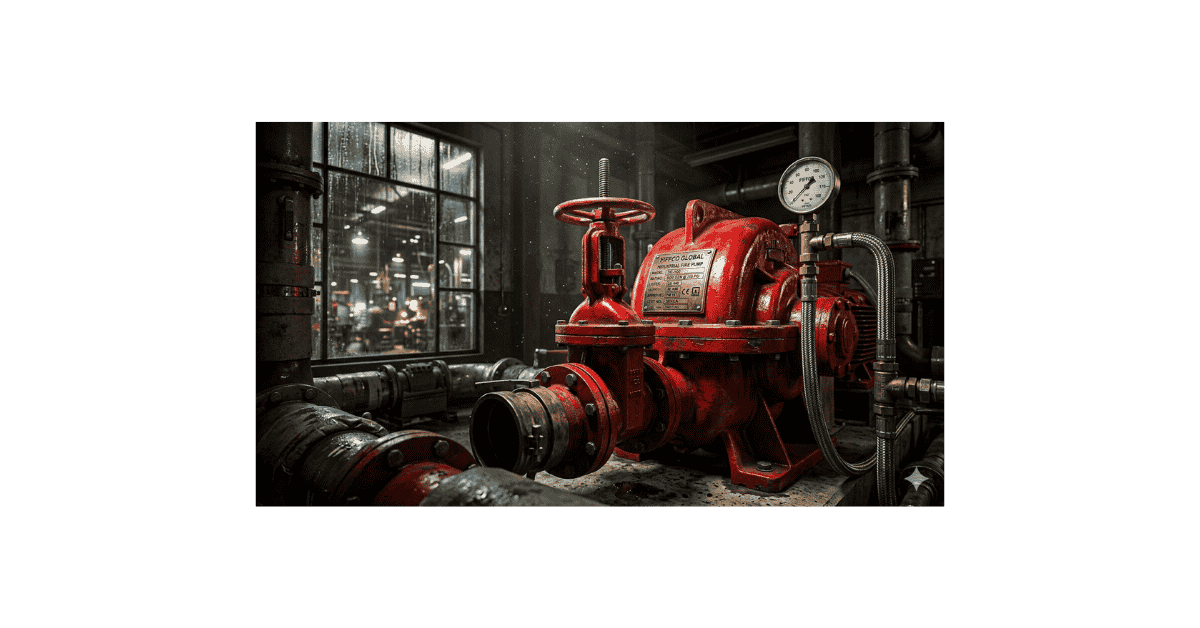
In areas where the municipal water pressure is too low, we install Fire Pumps and storage tanks. These ensure that even if the town’s water supply fluctuates, your building has a dedicated, high-pressure reserve ready to go.
Pipework and Fittings
Fire mains are typically constructed from ductile iron, galvanised steel, or high-density polyethylene (HDPE). These must be buried deep enough to avoid frost damage and designed to handle “water hammer”—the sudden pressure surge when a valve is opened or closed.
Relevant Standards & Compliance (UK & International)
Compliance isn’t just about avoiding fines; it’s about ensuring the equipment actually works when lives are on the line. At Fiffco Global, we manufacture equipment that meets the world’s most stringent testing protocols.
In the United Kingdom, the primary standard is BS 750, which specifies the requirements for underground fire hydrants and surface box frames. Furthermore, BS 9990 provides the code of practice for non-automatic fire-fighting systems in buildings, covering the design, installation, and testing of dry and wet fire mains.
Internationally, many of our clients follow NFPA 24 (Standard for the Installation of Private Fire Service Mains and Their Appurtenances). This is the gold standard used by the National Fire Protection Association (NFPA) (opens in new tab) and is often required for facilities insured by global firms.
Our equipment also undergoes rigorous third-party testing:
- UL / FM Approvals: These signify that the product has been tested to extreme limits.
- VdS Certifications: Crucial for European markets, particularly in Germany.
- CE/UKCA Marking: Mandatory for legal sale and installation in the UK and EU.
Fiffco Global supplies Fire Hydrants that comply with international standards — explore our range here: [https://fiffco.co.uk/fire-hydrants].
How to Install and Maintain Your Hydrant System — Step-by-Step
Maintenance is a legal requirement under the Regulatory Reform (Fire Safety) Order 2005. Here is how we recommend managing your system.
- Site Assessment and Hydraulic Calculation: Before a single pipe is laid, a fire engineer must calculate the “required flow rate.” This ensures the pipes are large enough to handle the volume of water the FRS will need.
- Depth and Bedding: Pipes must be buried at a minimum depth (usually 900mm in the UK) to protect against frost and heavy vehicle traffic. DO use thrust blocks at every bend to prevent the pipes from kicking out under pressure.
- Flushing the System: After installation, the system must be flushed to remove construction debris. A single pebble left in a pipe can destroy a fire engine’s centrifugal pump.
- Annual Pressure and Flow Testing: Once a year, you must perform a flow test to ensure the system hasn’t been throttled by scale build-up or partially closed valves.
- Visual Inspection of Outlets: Every six months, check for “pitting” (corrosion) on the threads of the hydrant and ensure the pits are clear of water and debris.
- Valve Exercising: Periodically turn every valve in the system to ensure they don’t seize over time. DON’T leave a hydrant system in an “off” state; if a section must be isolated, ensure the local fire brigade is notified immediately.
Common Mistakes & How to Avoid Them
Even the most well-funded facilities can fall into traps that compromise their fire safety. Here are the most frequent errors our team sees in the field:
- Paving Over Underground Hydrants: During resurfacing or landscaping, contractors often accidentally cover the “FH” cover with tarmac or soil. This makes the hydrant invisible to firefighters. The Fix: Ensure all hydrants are mapped and the covers are painted yellow as per UK regulations.
- Neglecting Backflow Prevention: If a fire pump kicks in and pushes water back into the municipal main, it can contaminate the local drinking water. The Fix: Install high-quality, certified check valves that meet water authority standards.
- Inadequate Pipe Support: In larger facilities, pipes are often suspended from ceilings. If the supports aren’t designed for the weight of a water-filled pipe under pressure, the whole system can collapse during a fire. The Fix: Use FM-approved hangers and seismic bracing where required.
- Lack of Training: We often see security staff who have no idea how to operate the main isolation valve. The Fix: Include fire hydrant system orientation in your quarterly safety briefings for all facility staff.
Real-World Applications / Case Study Angle
To understand why these systems are diverse, let’s look at two distinct scenarios.
Scenario 1: The High-Rise Commercial Hub
In a 20-storey London office tower, external hydrants are only part of the story. The building requires a “Wet Riser”—an internal hydrant system that is permanently charged with water. Because the height of the building makes it impossible for a fire engine to pump water to the top floor effectively, the building uses a series of Fiffco Global fire pumps to boost pressure at every level. This ensures that a firefighter on the 19th floor has the same water pressure as someone on the ground.
Scenario 2: The Remote Logistics Warehouse
Consider a 50,000 square-metre warehouse located far from the municipal water network. A standard hydrant wouldn’t have enough pressure. In this case, we implement a Private Fire Main connected to a massive on-site storage tank. The system is designed with multiple pillar hydrants spaced exactly 90 metres apart, ensuring that no matter where a fire starts, the fire service has a connection point within reach.
Frequently Asked Questions (FAQ)
How often should fire hydrants be tested in the UK?
According to BS 9990, fire hydrants and dry/wet risers should undergo a visual inspection every six months and a full hydraulic pressure test annually. This ensures that the valves operate correctly and that there are no leaks in the underground pipework.
What is the difference between a wet riser and a dry riser?
A dry riser is an empty pipe that firefighters pump water into from the outside. A wet riser is permanently filled with water from a tank and pump system. Generally, buildings over 50 metres in height require wet risers because the time taken to fill a dry pipe would be too great.
Can I use a fire hydrant for general cleaning or irrigation?
Absolutely not. Using a fire hydrant for non-emergency purposes without a permit from the water authority is illegal in the UK. Furthermore, frequent non-emergency use can wear out the seals, leading to failure when the equipment is actually needed for life safety.
Why are fire hydrants painted yellow in the UK?
Yellow is the standard colour for fire hydrant covers and marker plates in the UK to ensure high visibility for the fire service, especially at night or in poor weather. This is governed by BS 750 to ensure consistency across all regions.
What is a “Static Water Supply” (SWS)?
An SWS is a source of water that is not under pressure, such as a tank, pond, or pool. In rural areas, a fire hydrant system might be designed to “draft” water from these sources using a pump, providing a reliable supply where town mains are insufficient.
Why Choose Fiffco Global for Fire Hydrant Systems?
Fiffco Global is more than just a manufacturer; we are a dedicated partner in life safety. Based at 20-22 Wenlock Road, London, we combine British engineering heritage with a global supply chain that serves the most demanding industries in the world.
Our products are engineered to exceed the requirements of UL, FM, VdS, CE, and NFPA. We understand that when a fire hydrant is opened, there is no room for error. That is why every valve, pipe fitting, and hydrant we trade or manufacture undergoes rigorous quality control before it reaches your site. We specialise in helping contractors and engineers navigate the complexities of international standards, ensuring your project is compliant from day one.
Whether you are looking for a single underground hydrant for a small development or a complete Fire Pump and hydrant package for a multi-billion pound infrastructure project, our team has the expertise to deliver. We are committed to innovation, constantly updating our product lines to meet the evolving needs of the fire protection industry.
Explore our full range of fire fighting equipment at https://fiffco.co.uk/products or contact our team of specialists today at info@fiffco.co.uk for technical advice on your next project.
Conclusion
A fire hydrant system is the silent guardian of our built environment. While it remains unused for the vast majority of its life, its performance during those few critical minutes of an emergency can define the difference between a minor incident and a catastrophe.
By understanding the importance of BS 750 and BS 9990 standards, maintaining a rigorous inspection schedule, and choosing certified equipment from a trusted partner like Fiffco Global, you are doing more than just ticking a compliance box—you are protecting lives and livelihoods.
If you have questions about upgrading an existing system or are in the early stages of a new build, don’t leave your safety to chance. Browse our range of Fire Hydrants or reach out to us at Contact Us to ensure your facility is equipped with the best fire protection technology available.