

Published: April 2026 | Last Updated: April 2026 Author: Fiffco Global Technical Team | Reviewed by: Fire Safety Engineering Specialist
Introduction
Imagine a small electrical arc inside a single server rack at 2:00 AM. In a standard office, a water sprinkler might eventually activate, dousing the flames but simultaneously destroying every piece of hardware in the room. For a data centre, the “successful” extinguishment of a fire with water is often just as catastrophic as the fire itself, leading to total data loss, hardware corrosion, and weeks of downtime. Industry data suggests that a significant percentage of businesses that experience a major data loss event never fully recover, closing their doors within two years.
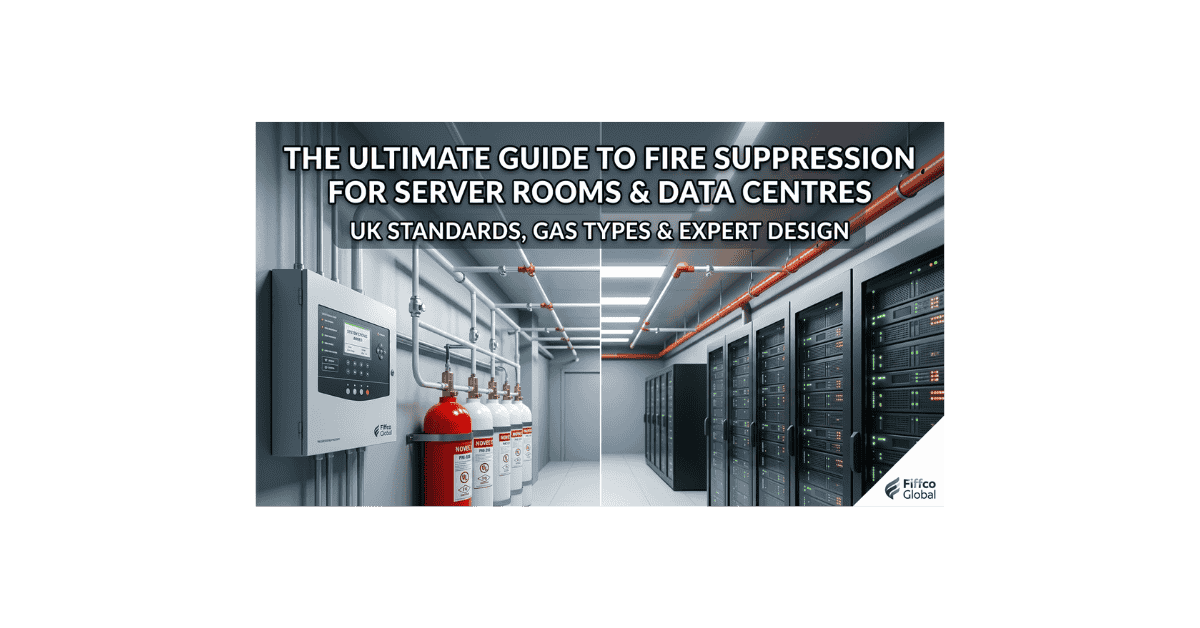
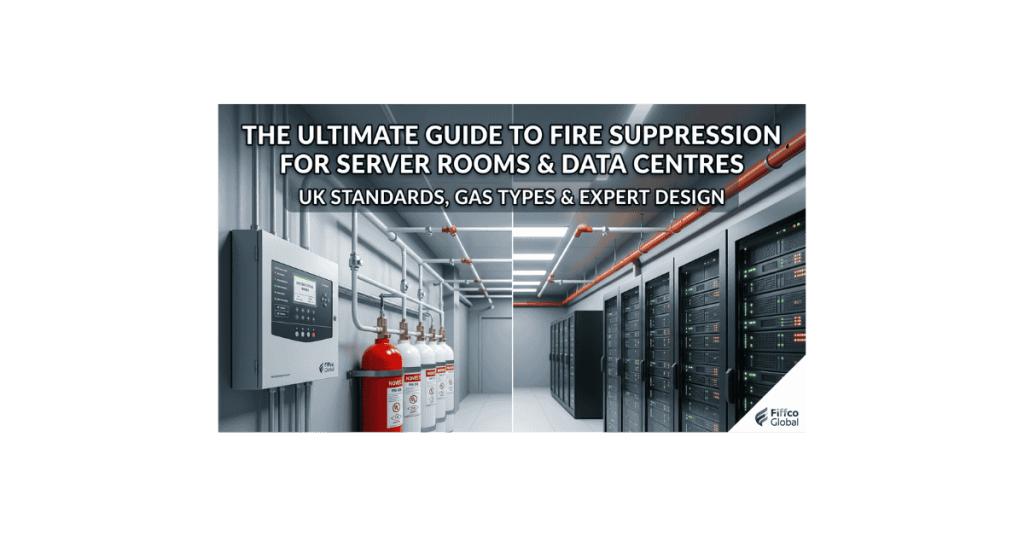
When managing high-value IT infrastructure, the goal isn’t just to put out a fire; it’s to do so without leaving a trace. A specialized fire suppression system for server rooms is designed to detect and neutralise a fire at its earliest stages, often before a human could even smell smoke. These systems use “clean agents”—gases that interrupt the combustion process without conducting electricity or leaving behind messy residues that ruin motherboards.
This article serves as a comprehensive resource for facility managers, MEP contractors, and IT directors. We will break down the mechanics of gas-based suppression, navigate the complex web of UK and international safety standards, and provide a step-by-step framework for choosing a system that protects both your life safety obligations and your digital assets.
By the end of this guide, you will understand the critical differences between synthetic and inert gases, how to ensure your room is “gas-tight,” and why regular maintenance is the only way to guarantee your multi-million-pound investment doesn’t fail when the heat is on.
What Is a Fire Suppression System for Server Rooms? (Definitions & Overview)
At its core, a fire suppression system for server rooms is a non-water-based fire protection solution engineered specifically for “Class E” (electrical) fire risks. Unlike traditional sprinklers that rely on cooling and smothering via water, these systems use gaseous agents to either chemically inhibit the fire’s chain reaction or reduce oxygen levels to a point where combustion cannot be sustained.
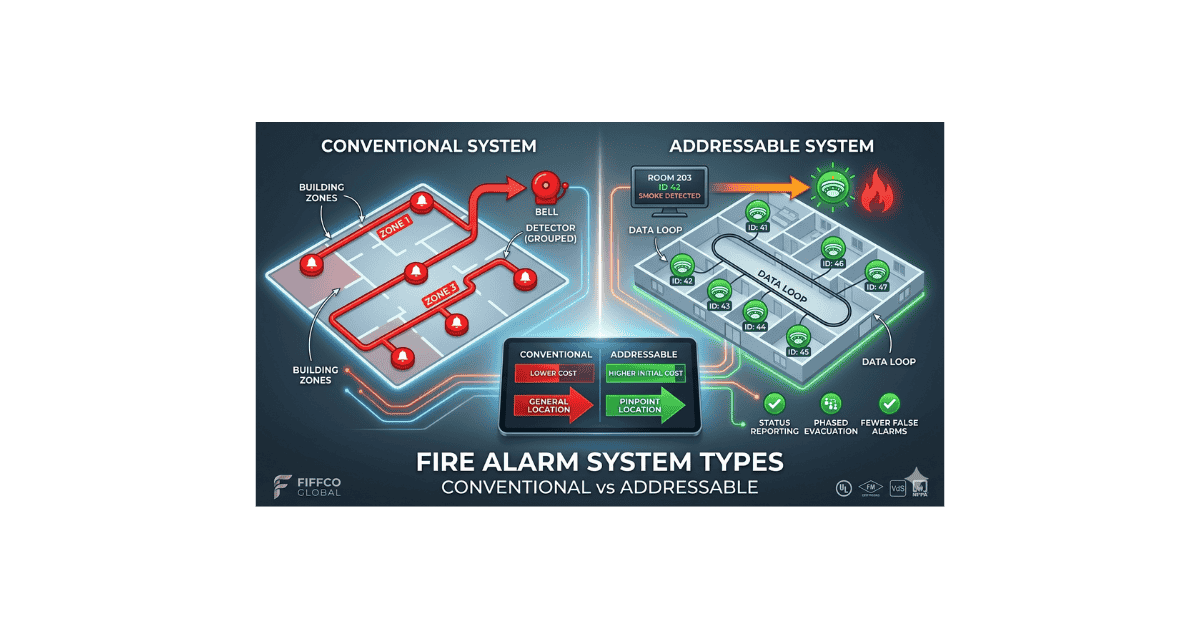
Technically, these systems operate through a combination of highly sensitive detection and rapid discharge. High Sensitivity Smoke Detection (HSSD), often referred to as “aspirating” systems, constantly sniff the air for microscopic particles of combustion. Once a fire is confirmed, the system releases a predetermined volume of gas from high-pressure cylinders through a network of piping and nozzles. This “total flooding” approach ensures that even the deepest recesses of a server rack are protected.
These systems are essential in environments where “business continuity” is the priority. This includes:
- Colocation Data Centres: Where uptime is a contractual obligation.
- Telecommunications Hubs: Where signal integrity must be maintained.
- On-site Server Closets: For small-to-medium enterprises (SMEs) protecting local databases.
- Control Rooms: In power plants or manufacturing facilities.
The importance of these systems extends beyond property protection. While servers can be replaced, the data they hold is often irreplaceable. Furthermore, by using clean agents, we ensure that the environment remains safe for personnel to evacuate and that the building’s structural integrity isn’t compromised by smoke damage or water weight.
Key Components / Types / How It Works
Clean Agent Chemicals (FM-200 / Novec 1230)
Synthetic agents like FM-200 (HFC-227ea) or the newer Novec 1230 (FK-5-1-12) are stored as liquids under pressure and turn into gas upon discharge. They work primarily by absorbing heat from the fire at a molecular level. Pro Tip: Novec 1230 is widely considered the future-proof choice due to its Global Warming Potential (GWP) of 1, making it exempt from many F-Gas environmental phase-outs.
Inert Gas Systems (IG-55, IG-541, Nitrogen)
Inert gases use naturally occurring elements like Nitrogen or Argon. They work by reducing the oxygen concentration in the room from 21% to roughly 12-13%. This is enough to kill a fire but still allows humans to breathe safely for a short duration during evacuation. Example: In a large-scale data hall, an IG-541 (Inergen) system might be preferred because the gas can be piped over longer distances from a central cylinder bank.
Detection and Control Panels
The “brain” of the system. In server rooms, we typically use “Double Knock” logic. This means the gas won’t discharge until two separate detectors confirm smoke, preventing expensive accidental discharges caused by a single faulty sensor.
Discharge Nozzles and Pipework
Precisely engineered nozzles ensure the gas is distributed evenly throughout the space. Always ensure your pipework is calculated using specialized hydraulic software to guarantee the gas reaches the required concentration within 10 seconds.
Relevant Standards & Compliance (UK & International)
Compliance in fire safety isn’t just about avoiding fines; it’s about ensuring the system actually works when lives are on the line. In the UK, the primary standard is BS EN 15004, which covers the design, installation, and maintenance of gaseous fire extinguishing systems.
On an international level, the NFPA 2001 (Standard on Clean Agent Fire Extinguishing Systems) is the most widely recognised benchmark. Most high-tier data centres require systems that are not only designed to these standards but also feature components with UL Listing or FM Approval. These third-party certifications from UL Certifications and FM Approvals prove that the hardware has undergone rigorous “live fire” testing.
Fiffco Global supplies Gas Suppression components that comply with international standards — explore our [clean agent systems] range here: [https://fiffco.co.uk/clean-agent-systems].
Furthermore, the UK Health & Safety Executive (HSE) provides strict guidelines on the use of inert and chemical gases in occupied spaces. Building owners must perform a “Room Integrity Test” annually to ensure the room can actually hold the gas for the required 10-minute “soak time.” If your server room has unsealed cable entries or gaps under doors, the gas will leak out, and the fire will re-ignite.
How to Choose / Install / Maintain Your System — Step-by-Step
- Conduct a Hazard Analysis: Determine the volume of the room, the types of cables used, and the presence of raised floors or false ceilings.
- Select the Right Agent: Choose between synthetic (fast-acting, space-saving) or inert (environmentally neutral, better for large distances) based on your footprint.
- Calculate Gas Quantity: Use professional software to determine the exact weight of gas needed for the room’s volume at a specific temperature. DO account for the volume of the “voids” above the ceiling and below the floor.
- Install Detection and Notification: Place smoke detectors at the return air grilles of CRAC units, as this is where smoke naturally drifts in a high-airflow environment.
- Seal the Room: Ensure all penetrations (pipes, cables, ducts) are fire-stopped. DON’T forget to install automated dampers on HVAC ducts that close immediately upon system activation.
- Commissioning and Integrity Testing: Perform a fan-pressure test to ensure the room is airtight enough to maintain gas concentration.
- Schedule Semi-Annual Maintenance: Check cylinder pressures, test the control panel batteries, and inspect nozzles for obstructions.
Common Mistakes & How to Avoid Them
- Ignoring the Raised Floor: Many contractors forget that smoke and fire often start in the cabling beneath the floor. If you don’t have detectors and nozzles in the floor void, your system is half-blind. Always treat the floor void as a separate protected zone.
- Overlooking Over-Pressure Venting: When gas is discharged at high speed, it creates a massive pressure spike. Without a pressure relief vent, you risk blowing out windows or dislodging ceiling tiles. Ensure a certified vent is installed.
- Moving Racks Without Recalculation: If you add more server racks, you change the “free volume” of the room. This can lead to an over-concentration of gas, which might be hazardous to occupants. Recalculate your requirements whenever the room layout changes significantly.
- Lack of Staff Training: Employees often panic when the alarm sounds. If they don’t know how to use the manual pull stations or the “abort” buttons, the system becomes a liability. Conduct regular drills.
Real-World Applications / Case Study Angle
Scenario 1: The Urban Financial Data Hub In a high-rise commercial building in the UK, a boutique investment firm occupied the 14th floor. Their server room was small but contained the firm’s entire trading history. Space was at a premium. We recommended a Novec 1230 system because the cylinders are compact and the agent is safe for the sensitive electronics nearby. When a power supply unit failed and began to smoulder, the aspirating smoke detection triggered the system. The fire was suppressed in seconds, and the firm was back to full operations by the start of the next trading day.
Scenario 2: The Industrial Manufacturing Server Room For a petrochemical facility, the server room was located near a high-vibration area. Traditional smoke detectors were prone to false alarms. By implementing a Fire Alarm System integrated with a CO2 or Inert Gas suppression strategy using ruggedised sensors, the facility avoided “nuisance” discharges while ensuring that the critical PLC (Programmable Logic Controller) systems were protected from fire.
Frequently Asked Questions (FAQ)
Is FM-200 or Novec 1230 safer for my staff?
Both are considered safe for use in occupied spaces when designed at the correct concentration. However, Novec 1230 has a wider safety margin between its design concentration and its “No Observed Adverse Effect Level” (NOAEL), making it slightly more forgiving if a discharge occurs while people are still in the room.
How often do I need to test the room integrity?
According to British Standards and BSI guidelines, a Room Integrity Test should be conducted at least once every 12 months. It should also be repeated if any structural changes are made to the room, such as drilling new holes for data cables.
Will a fire suppression discharge damage my hard drives?
The gas itself is non-conductive and leaves no residue. However, the sound of a high-pressure discharge can sometimes cause “vibration-induced” errors in older spinning hard drives (HDDs). Modern systems often use “silenced” nozzles to reduce decibel levels and protect sensitive storage arrays.
Can I use a standard fire extinguisher in a server room?
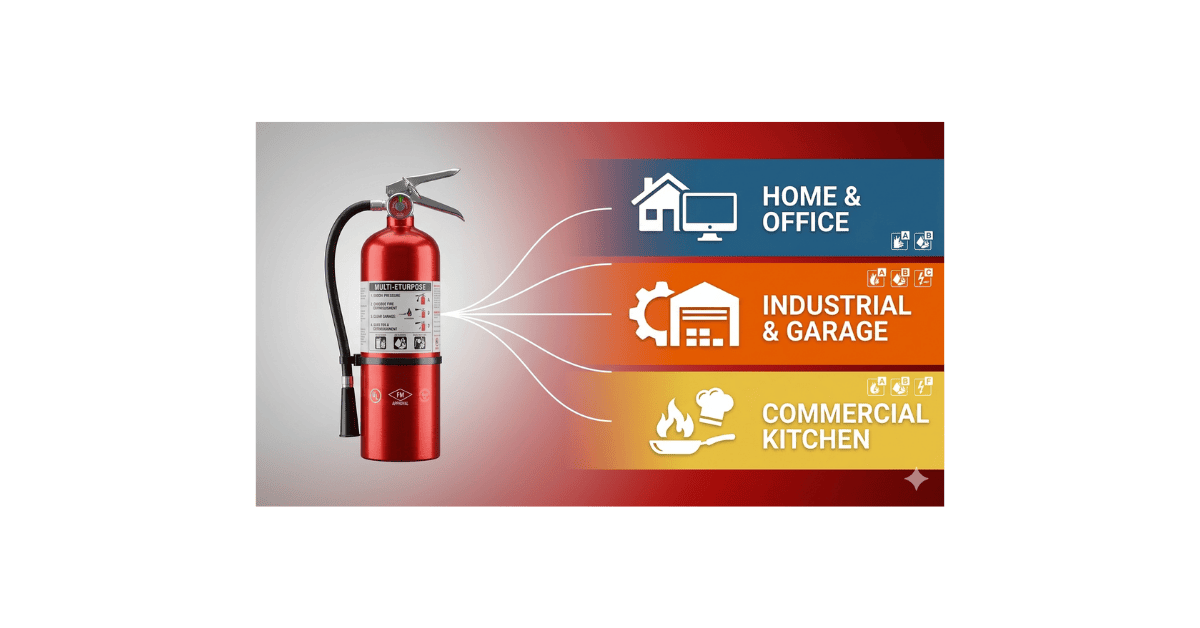
You should only use CO2 or specialized “Clean Agent” Fire Extinguishers. Never use powder extinguishers, as the fine dust will coat every circuit board and is nearly impossible to clean, effectively “bricking” your hardware even if there was no fire damage.
What happens if the gas leaks out before the fire is out?
This is why the “soak time” is critical. If the room isn’t sealed, the gas concentration drops, oxygen returns, and the fire can re-ignite from the residual heat. This highlights the absolute necessity of a professional room seal and integrity test.
Why Choose Fiffco Global for Data Centre Safety?
At Fiffco Global, we understand that fire protection for data centres isn’t just about selling hardware; it’s about providing a “zero-fail” safety net for your digital infrastructure. As a UK-based manufacturer and trader operating out of London, we provide the localized expertise and rapid response that mission-critical facilities require.
Our products carry the industry’s most prestigious certifications, including UL, FM, VdS, CE, and NFPA. This ensures that every valve, nozzle, and cylinder we supply meets the highest global benchmarks for reliability. Whether you are a local IT manager or a global procurement officer for a hyperscale data centre, our team has the technical depth to support your project from design to commissioning.
We maintain a robust global supply chain, ensuring that whether you need Fire Protection Valves or a full-scale Gas Suppression solution, we can deliver on time and within budget. Our commitment to innovation means we are constantly evolving our product range to include the most environmentally friendly agents available on the market today.
Explore our full range of [fire protection equipment] at https://fiffco.co.uk/products or contact our team at info@fiffco.co.uk to discuss your specific server room requirements.
Conclusion
Protecting a server room requires a shift in mindset—from “putting out the fire” to “preserving the environment.” A properly designed fire suppression system for server rooms is the only way to ensure that a minor electrical fault doesn’t turn into a business-ending catastrophe. By selecting the right clean agent, adhering to BS EN and NFPA standards, and maintaining a rigorous integrity testing schedule, you can operate with total confidence.
The cost of a suppression system is a fraction of the cost of a single day of data centre downtime. Don’t wait for a “near miss” to evaluate your fire strategy.
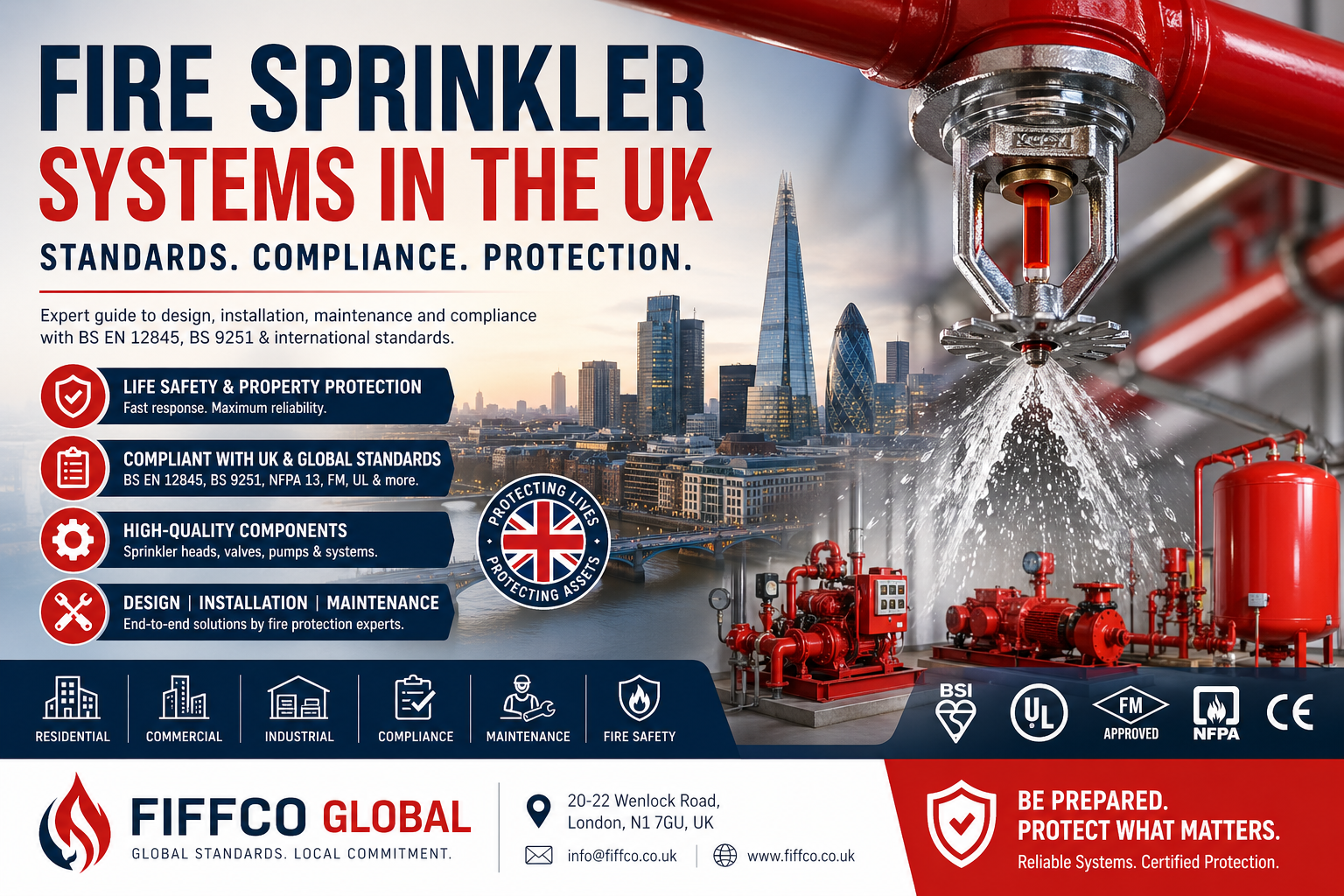
If you are looking to upgrade your current fire protection or are in the early stages of a new build, our specialists are here to help. Explore our Sprinkler Systems for surrounding office areas or dive into our Gas Suppression range today to find the perfect fit for your facility.