



By Fiffco Global Fire Safety Engineering Team
Table of Contents
- Introduction
- Understanding What a Fire Hose Nozzle Does
- Why Choosing the Right Nozzle Matters
- Types of Fire Hose Nozzles (Explained with Pros & Cons)
- Key Factors to Consider When Choosing a Nozzle
- Application Type
- Flow Rate
- Pressure Rating
- Stream Pattern
- Material
- Size & Coupling
- Industry Standards & Compliance
- Real-World Case Studies
- Common Mistakes to Avoid
- Frequently Asked Questions
- Conclusion & CTA
- Author Bio
1. Introduction
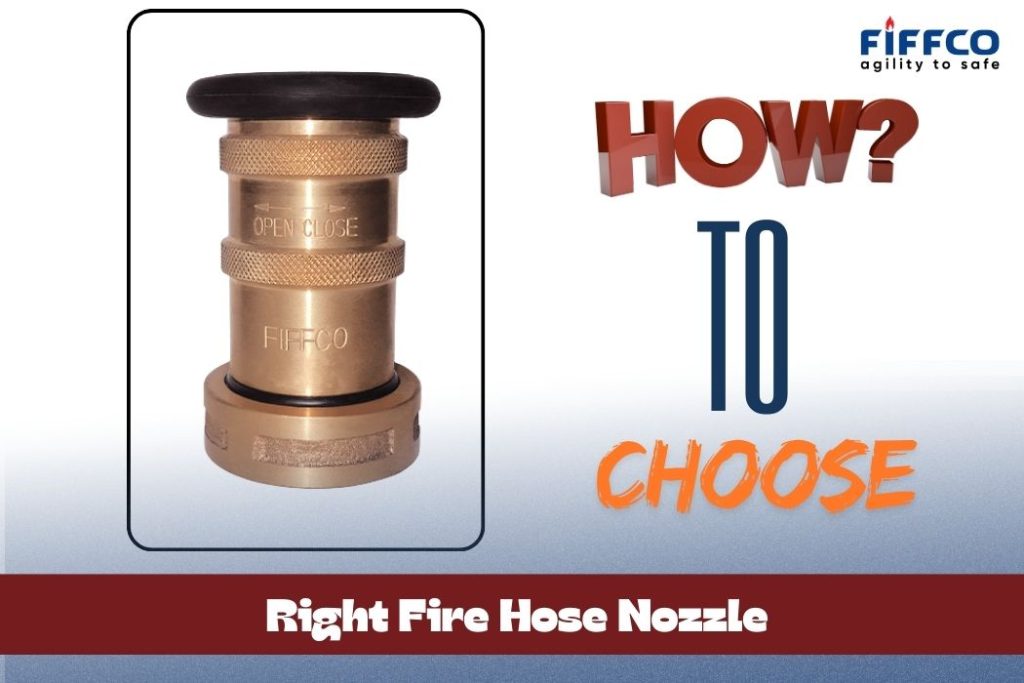
Choosing the right fire hose nozzle is one of the most important decisions in fire suppression—yet it’s also one of the most misunderstood. Whether you’re part of an industrial facility, fire brigade, marine environment, warehouse, or even an offshore operation, the nozzle determines how effectively water or foam reaches the fire.
However, with so many nozzle types, flow rates, PSI ratings, and design variations, knowing which one to use isn’t always straightforward.
This comprehensive guide will help you:
- Understand how nozzles work
- Know which nozzle is right for each application
- Compare flow rates, patterns, and pressure requirements
- Avoid costly purchasing mistakes
- Make an informed decision based on safety standards
- Learn from real-world fire-safety experience
This guide is crafted using industry knowledge, NFPA standards, and hands-on engineering experience from the Fiffco Global team—specialists in global fire-safety product supply and engineering solutions.
2. Understanding What a Fire Hose Nozzle Does
A fire hose nozzle is more than just a water outlet. It is a precision tool that controls:
- Water flow
- Stream pattern
- Pressure
- Reach
- Application type
In fire suppression, controlling water delivery is everything. An inefficient nozzle leads to:
❌ Ineffective fire attack
❌ Water wastage
❌ Delayed response
❌ Increased property damage
❌ Increased risk to personnel
A proper nozzle ensures:
✅ Rapid knockdown
✅ Correct stream pattern
✅ Optimal flow rate
✅ Firefighter safety
✅ Efficient water usage
3. Why Choosing the Right Nozzle Matters
Not all fires are the same—and not all environments demand the same tools.
The nozzle you choose directly impacts:
✔ Fire suppression efficiency
High-risk environments (chemical plants, fuel storage, factories, power plants) require nozzles capable of handling specific hazards.
✔ Safety of the team
Incorrect nozzles can create excessive nozzle reaction force, leading to injuries.
✔ Water & foam consumption
In marine and offshore applications, water supply can be limited—nozzle selection becomes critical.
✔ Compliance and liability
Many industries require compliance with NFPA, EN, or UL/FM ratings.
4. Types of Fire Hose Nozzles (With Pros & Cons)
Understanding nozzle types helps you choose based on your application.
1. Smooth Bore Nozzle (Solid Stream Nozzle)
Best for: Long-range, penetrating fires, industrial fires.
Pros:
- Long-distance reach
- Excellent for exterior fire attack
- Works well in low-pressure environments
- Less mechanical complexity
Cons:
- No adjustable pattern
- Not ideal for interior structural fires
2. Adjustable Fog Nozzle
Best for: Structural firefighting, indoor attacks, smoke cooling.
Pros:
- Multiple spray patterns
- Can create protective fog curtain
- Great for ventilation and heat reduction
Cons:
- Requires stable pressure
- More mechanical parts → more maintenance
3. Automatic Nozzle
Best for: Fire brigades needing constant pressure regardless of flow variation.
Pros:
- Maintains steady pressure
- Flexible flow range
- Great for unpredictable water supply
Cons:
- More expensive
- Complex internal mechanism
4. Fixed Gallonage Nozzle (Constant Flow Nozzle)
Best for: Industrial fire suppression where consistent flow is essential.
Pros:
- Predictable performance
- Reliable and easy to train
- Good for foam application
Cons:
- Limited flexibility
5. Foam Nozzles
Best for: Class B fires (flammable liquids), petrochemical plants, fuel depots.
Pros:
- Designed specifically for foam expansion
- Essential for oil and chemical fires
Cons:
- Not suitable for general water-based firefighting
6. High-Pressure Nozzles
Best for: Wildfire operations, high-rise buildings.
Pros:
- Lightweight
- Long-distance spray
- Great for mobility
Cons:
- Lower water flow volume
5. Key Factors to Consider When Choosing a Fire Hose Nozzle
Selecting the right nozzle depends on a combination of factors. Below is a comprehensive breakdown.
1. Application Type
Different environments require different nozzle capabilities:
| Application | Recommended Nozzle |
| Structural firefighting | Adjustable Fog or Automatic |
| Industrial plants | Constant Flow / Smooth Bore |
| Chemical & fuel storage | Foam Nozzles |
| Marine & offshore | Automatic / Foam |
| Wildfire | High-Pressure Nozzle |
| High-rise buildings | Fog Nozzle |
2. Flow Rate (GPM/LPM)
Flow rate determines how much water the nozzle can deliver.
Typical ranges include:
- 60–80 GPM: Light interior use
- 95 GPM: Standard structural firefighting
- 125–150 GPM: Industrial
- 250+ GPM: High-risk industrial, oil & gas
NFPA recommends 150 GPM minimum for aggressive interior fire attack.
3. Pressure Rating (PSI/Bar)
Most nozzles operate at:
- 100 PSI (7 bar) – Fog nozzles
- 50 PSI (3.5 bar) – Smooth bore nozzles
- Variable pressure – Automatic nozzles
Always match nozzle pressure with pump and hose capabilities.
4. Stream Pattern Options
- Straight Stream – Maximum reach
- Narrow Fog – Useful for cooling
- Wide Fog – Heat shielding
- Foam Jet – For Class B hazards
Your nozzle should offer patterns appropriate for your environment.
5. Material Construction
Nozzle materials determine durability, especially in industrial and marine conditions.
Best materials include:
- Anodized Aluminum – lightweight, corrosion-resistant
- Brass – durable and heat-resistant
- Stainless Steel – high corrosion resistance
- Composite/Polymer – lightweight but limited industrial use
6. Size & Couplings
Ensure compatibility with:
- Hose size (1”, 1.5”, 2.5”, etc.)
- Couplings (British Standard, NST, Storz, BSP, etc.)
- Adaptors used on-site
6. Industry Standards & Compliance
At Fiffco Global, we recommend selecting nozzles compliant with:
- NFPA 1964: Standard for Spray Nozzles
- EN 15182 (European standards for nozzle performance)
- UL Listed / FM Approved products
- ISO 9001 Manufacturing Standards
Compliance ensures safety, performance reliability, and product longevity.
7. Real-World Case Studies (Experience-Based)
Case Study 1: Petrochemical Plant, Jebel Ali – UAE
A client experienced poor foam expansion during a fuel leak fire drill.
Problem: Incorrect fog nozzle used for foam application.
Solution (Fiffco Recommendation):
We replaced it with an Aspirating Foam Nozzle, resulting in improved extinguishing performance and 40% faster knockdown during training.
Case Study 2: Textile Factory, Dhaka – Bangladesh
A factory struggled to maintain water pressure during fire safety drills.
Problem: Using a constant-flow nozzle with insufficient pump capacity.
Solution:
We recommended Automatic Pressure Nozzles, which compensated for fluctuating pressure—leading to more stable firefighting performance.
Case Study 3: Marine Vessel – Singapore
Corrosion damaged multiple brass nozzles.
Solution:
We supplied marine-grade stainless-steel nozzles, resulting in longer durability and reduced maintenance cost by 60%.
8. Common Mistakes to Avoid
❌ Buying the cheapest nozzle
❌ Ignoring flow rate/pressure compatibility
❌ Using water nozzles for foam operations
❌ Not considering corrosion resistance in marine environments
❌ Failing to verify certification
❌ Using fog nozzles in high-wind outdoor conditions
9. Frequently Asked Questions (FAQ)
- Which nozzle is best for industrial factories?
Constant-flow or automatic nozzles with high GPM ratings are ideal for industrial settings.
- What is the standard GPM for firefighting nozzles?
95–150 GPM is typical, depending on the environment.
- Do I need a foam nozzle for chemical storage?
Yes—foam nozzles are essential for Class B fires.
- Should I choose aluminum or brass nozzles?
Aluminum is lighter; brass is more durable. Select based on environmental conditions.
- Are automatic nozzles good for low-pressure systems?
Yes—they adapt to changing pressures and maintain efficient stream patterns.
10. Conclusion & Call to Action
Selecting the right fire hose nozzle is not just about performance—it’s about safety, efficiency, compliance, and reliability. With the right nozzle, you can:
- Reduce fire damage
- Improve firefighter safety
- Optimize water or foam usage
- Ensure regulatory compliance
At Fiffco Global, we supply certified, industry-grade fire hose nozzles worldwide, ensuring that every client gets the right product for the right application.
👉 Need help selecting the perfect nozzle?
Visit: Fiffco Global – https://fiffco.co.uk/
Or contact our fire engineering team for expert guidance.
11. Author Bio
Fiffco Global Fire Safety Engineering Team
With over 15+ years of expertise in global fire protection solutions, our team specializes in industrial fire systems, marine safety equipment, MEP engineering, and NFPA-compliant firefighting products. We combine real-world field experience with global standards to deliver trustworthy and authoritative fire-safety knowledge.